Viltrox AF 50 mm f/1.4 Pro
5. Real relative aperture
Still the more we thought about it the more we wondered about too high resolution results at higher values of relative apertures. They suggested that the Viltrox might not close its aperture to declared values. A comparison, shown in the previous chapter, concerned lenses tested on different detectors. In order to avoid this problem we decided to compare the Viltrox with other Nikon Z system lenses that lately managed to break resolution records. We think here about the Nikon Z 135 mm f/1.8 Plena and the Nikon Z 35 mm f/1.2 S and an appropriate graph can be found below.
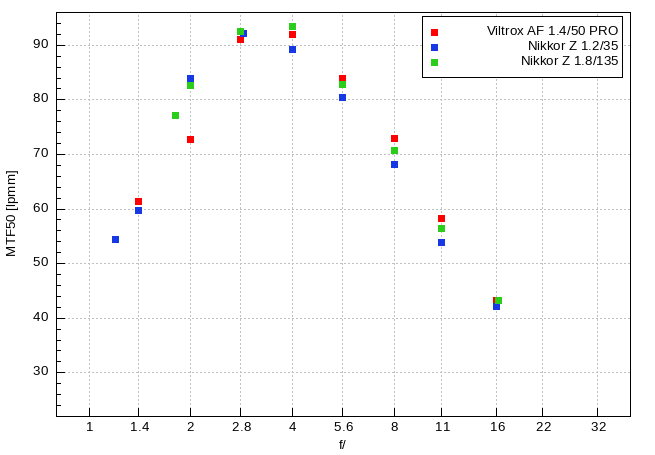
As you can notice, up from f/5.6 the Viltrox reaches the highest results here, with an exception of the f/16 aperture where all results are, within the margin of error, the same. Even though the differences aren't that pronounced, we decided to take a closer look at this issue anyway.
Please Support UsIf you enjoy our reviews and articles, and you want us to continue our work please, support our website by donating through PayPal. The funds are going to be used for paying our editorial team, renting servers, and equipping our testing studio; only that way we will be able to continue providing you interesting content for free. |
- - - - - - - - - - - - - - - - - - - - - - - - - - - - - - - - - - - - - - - - - - - - - - - -
In the case of a manual lens, taking photos of its closing aperture is simple. When you deal with a model with contacts and autofocus, it's a bit trickier. Such a lens has to be attached to a body because otherwise you can't stop down its aperture to a declared value. At the same time, if you want to illuminate everything properly you have to position lamps very close because the aperture is situated quite deep inside the optical system.
Our photos were taken with the Sony A7R V camera and the Sigma A 105 mm f/2.8 OS DG DN Macro. The choice was hardly accidental. A high resolution of this detector allows us to get a significant dimension of the photographed aperture, expressed in pixels, in our photos. The focal length of the Sigma allows also to take photos of the aperture of the Viltrox from a distance of good several meters, a good simulation of rays of light falling from infinity. At the same time the Sigma A 2.8/105 shows low distortion level even on full frame. As photos of the aperture take just the centre of the frame, never exceeding outside the dimensions of the APS-C sensor, their distortion is practically zero, without causing any significant errors in the measurements.
Sample photos reached by f/2.0 and f/16.0 we present below.
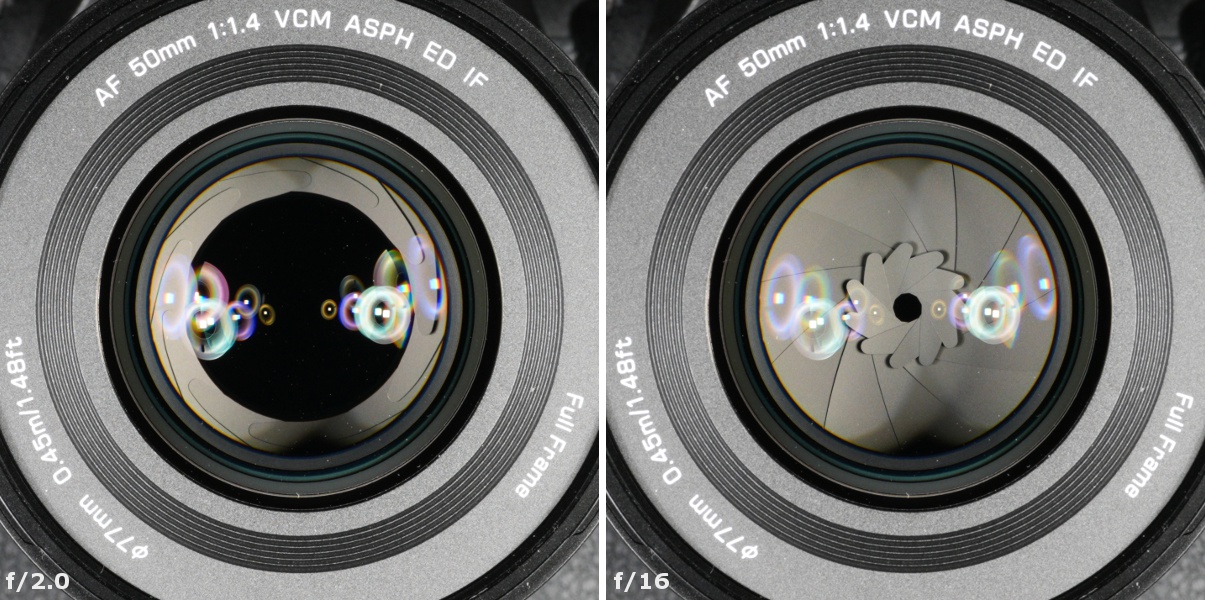 |
Assuming that the f/2.0 aperture is the equivalent of its real value, the next are as follows: f/2.799, f/3.940, f/5.627, f/7.892, f/11.341, and f/15.990. You can notice some fluctuations, but the ratio of dimensions between f/2 and f/16 amounts to 7.995. It should amount to 8 exactly so the situation is almost perfect.
It can also be counted the other way around. The ratio of dimensions of the consecutive pupils at consecutive apertures should amount to the square root of 2 exactly, so 1.4142. Between each of the consecutive apertures, you get six of such ratios and you can observe waverings frm 1.3997 to 1.4371. If you calculate arithmetic average of these six values you get 1.4141 so a value that differs from the square root of 2 by just one ten-thousandth! As you see, the compatibility is simply perfect.
You can state with great confidence that the Viltrox stops down its aperture properly well – it is certainly true for the apertures ranging from f/2.0 to f/16.0.
There are a bit more difficulties when you try to determine a real maximum relative aperture. In such a case the front of the lens presents itself as follows.
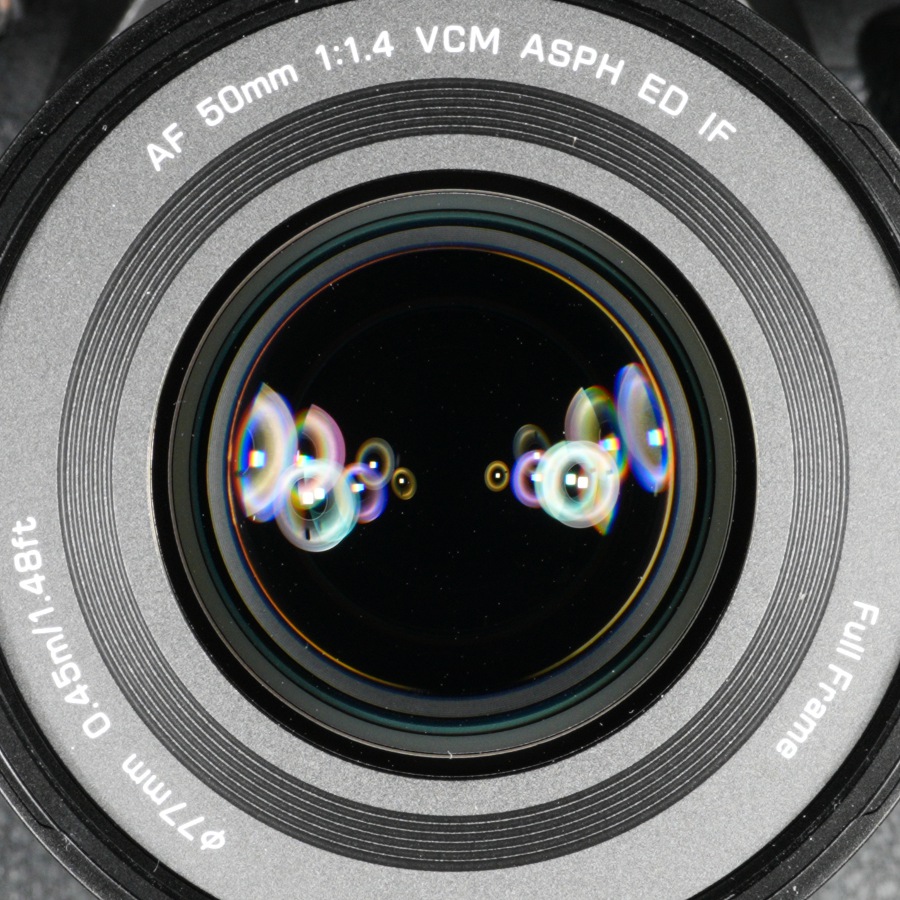 |
To be honest there is one more possibility here. You can assume that the Viltrox is indeed as fast as f/1.4 (and, to be precise, a square root of two, so 1.414). If it is true the producers lied a bit about the pupil's ratio amounting to 1.304 as you stop the lens down from f/1.4 to f/2.0. What's interesting, after that point all values are correct because, as we just showed, the average of pupil dimension ratios from f/2.0 to f/16.0 is as it should be, expressed in four decimals to boot. It is not an especially probable scenario, but if you assume it is real, you can present once more a graph of the Viltrox's resolution with real aperture values and compare it to graphs of both Nikkors.
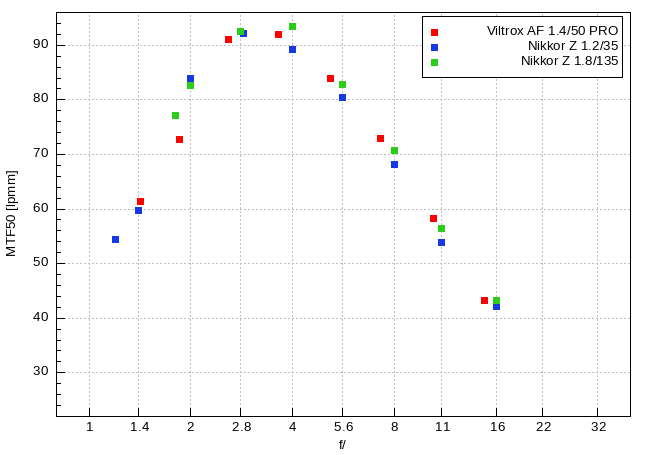
As you see the performance of all three lenses in an aperture range from near f/5.6 to f/16.0 fit together much better and create a more consistent group.
We didn't manage to reach here an unanimous conclusion here. I still think a scenario in which the Viltrox stops down the aperture properly but its real speed is a tad slower than f/1.4 is more probable. Of course I can't exclude a version in which this speed is in accordance with official specifications and the following aperture values are lower than indicated by parameters displayed on the screen and saved in EXIF format.