Panasonic Lumix S 100 mm f/2.8 Macro
8. Vignetting
As could be seen in the previous sections, however, data for the APS-C/DX sensor edge were retained for resolution and chromatic aberration measurements. In these cases, this was important because it provided us with additional information about the distribution of sharpness and chromatic aberration across the entire frame under analysis.
We will first discuss vignetting observed in JPEG files that have not been corrected for this effect. Let us recall that, in this case, we are dealing with an image that is practically free of distortion and has a field of view of 24.4 degrees.
Please Support UsIf you enjoy our reviews and articles, and you want us to continue our work please, support our website by donating through PayPal. The funds are going to be used for paying our editorial team, renting servers, and equipping our testing studio; only that way we will be able to continue providing you interesting content for free. |
- - - - - - - - - - - - - - - - - - - - - - - - - - - - - - - - - - - - - - - - - - - - - - - -
| S1R II, FF, JPEG, f/2.8 | S1R II, FF, JPEG, f/4.0 |

|

|
| S1R II, FF, JPEG, f/5.6 | S1R II, FF, JPEG, f/8.0 |

|

|
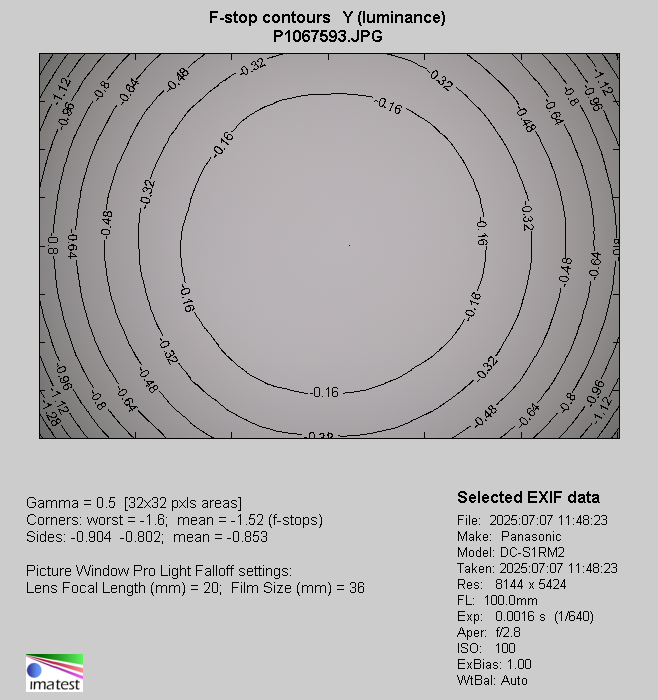
At the maximum aperture, the brightness fall-off in the very corner of the frame amounts to 41% (-1.52 EV). By comparison, the Sigma performed better here (36%), while the Nikkor did worse (51%). However, the Panasonic's result does not warrant strong criticism, as given its dimensions, we expected even poorer performance. In this category, it is in line with most of its competitors.
As expected, stopping down the aperture effectively reduces the effect in question. At f/4.0, the value is 23% (-0.76 EV), while at f/5.6 and f/8.0 vignetting becomes relatively unobtrusive, with results of 16% (-0.50 EV) and 11% (-0.33 EV), respectively. The problem disappears completely at f/11, where the effect in question reaches 10% (-0.31 EV).
As a bonus to this section, we can also check how vignetting looks in RAW files that have not been corrected for distortion. Let us recall that in this case, we have a slightly wider field of view and moderate pincushion distortion at our disposal.
| S1R II, FF, RAW, f/2.8 | S1R II, FF, RAW, f/4.0 |

|

|
| S1R II, FF, RAW, f/5.6 | S1R II, FF, RAW, f/8.0 |

|

|
In this case, at the maximum aperture, the brightness fall-off in the corners of the frame reaches 43% (-1.65 EV) and decreases to 27% (-0.91 EV) when the aperture is stopped down to f/4.0. Stopping down to f/5.6 reduces the effect to a modest 19% (-0.61 EV), while practically all the problems disappear at f/8.0 and f/11, where our results are 13% (-0.41 EV) and 12% (-0.38 EV), respectively.
| Panasonic S1R II, JPEG, 100 mm, f/2.8 |
 |