Viltrox AF 26 mm f/2.8 EVO
4. Image resolution
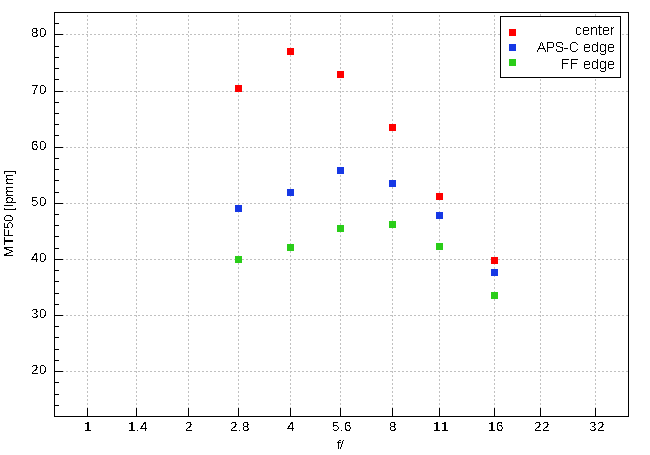
Let's see how the Viltrox AF 26 mm f/2.8 EVO performs in this context at the center of the frame, at the edge of the APS-C/DX sensor, and at the edge of the full-frame sensor.
Please Support UsIf you enjoy our reviews and articles, and you want us to continue our work please, support our website by donating through PayPal. The funds are going to be used for paying our editorial team, renting servers, and equipping our testing studio; only that way we will be able to continue providing you interesting content for free. |
- - - - - - - - - - - - - - - - - - - - - - - - - - - - - - - - - - - - - - - - - - - - - - - -
The center of the frame performs really well here. Even at the maximum aperture, the lens achieves a high resolution of 70 lpmm, and stopping down allows it to reach an excellent result of over 77 lpmm. It must be admitted, however, that the competition is very strong in this regard, and the Nikkor Z 26 mm f/2.8 managed to perform even better, although its advantage was only apparent at f/2.8. From f/4.0 onward, the two lenses were evenly matched.
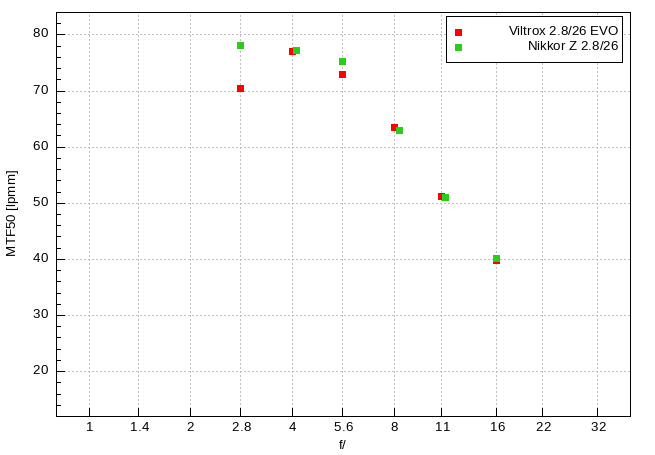
At the edges of the frame, the results are noticeably worse. This is understandable, as the compact dimensions of the tested lens impose significant limitations. Nevertheless, performance at the edge of the APS-C/DX sensor gives us no cause for concern, while the most challenging combination of the full-frame sensor's edge and an aperture of f/2.8 produces a result that is borderline acceptable. The minimum target has therefore been met, especially since the Viltrox actually performed slightly better in this respect than its Nikkor competitor.
One more issue remains to be discussed. The sample images suggested that, in some shots, the right side of the frame appeared less sharp than the left. Measurements using our test charts confirmed this effect, but only at f/2.8 and f/4.0. The differences were not substantial, never exceeding 20%. At the same time, as we will see in the following sections, the lens showed no differences between the left and right sides of the frame in terms of chromatic aberration or coma. It also exhibited low astigmatism, and its vignetting profile was perfectly symmetrical. This strongly suggests that the lens itself was not defective. The impression of uneven sharpness may also have resulted from a complex field curvature profile, which can be highly unusual in a pancake lens and produce substantial gradients in sharpness across different areas of the frame.
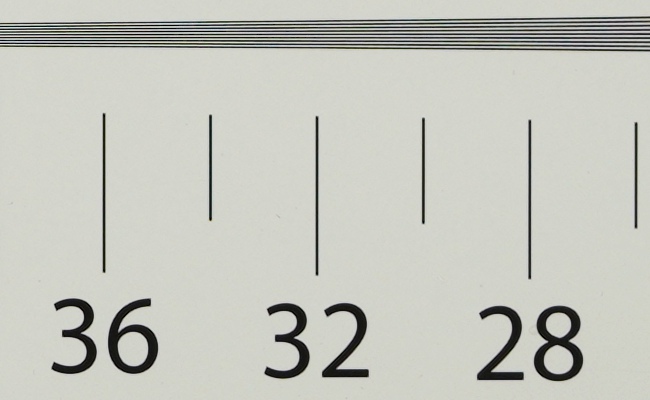
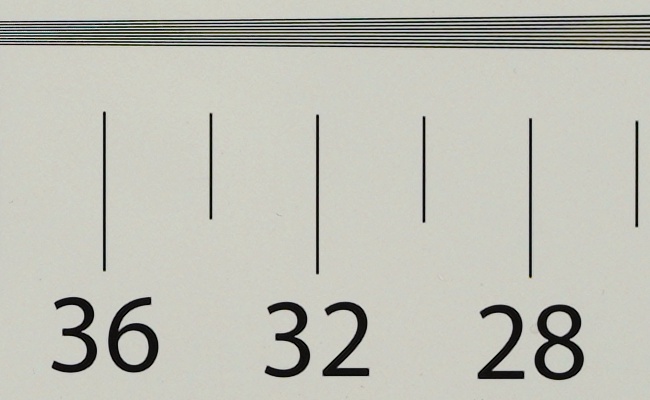
As usual, at the end of this section, we present crops from images of our resolution test chart, taken from JPEG files recorded simultaneously with the RAW files used in the analysis above.
| A7R IIIa, JPEG, 26 mm, f/2.8 |
 |
| A7R IIIa, JPEG, 26 mm, f/4.0 |
 |