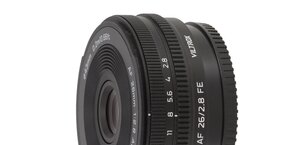
Viltrox AF 26 mm f/2.8 EVO
6. Distortion and field of view
Field of View
A rectilinear 26 mm lens should provide a field of view of 79.5 degrees on a full-frame sensor. Viltrox specifies a slightly larger value of 81.2 degrees for the AF 26 mm f/2.8 EVO. We therefore decided to check its actual field of view. To do so, we photographed the starry sky and used uncorrected JPEG files. We then transformed the pixel coordinates (X,Y) into equatorial coordinates (right ascension and declination), which describe the positions of stars in the sky. This allowed us to determine the lens's field of view very accurately, as it should be measured for rays arriving from infinity. The transformation was based on the positions of 151 stars distributed evenly across the entire image. The mean residual error of the coordinate grid fit was 43 arcseconds.
Our final result was 81.38 degrees, with an error of 0.04 degrees, making the actual field of view fractionally wider than the specification suggests. It also corresponds to a rectilinear focal length of 25.2 mm. It is relatively surprising that the manufacturer did not designate this lens as a 25 mm model.
Please Support UsIf you enjoy our reviews and articles, and you want us to continue our work please, support our website by donating through PayPal. The funds are going to be used for paying our editorial team, renting servers, and equipping our testing studio; only that way we will be able to continue providing you interesting content for free. |
- - - - - - - - - - - - - - - - - - - - - - - - - - - - - - - - - - - - - - - - - - - - - - - -
Distortion
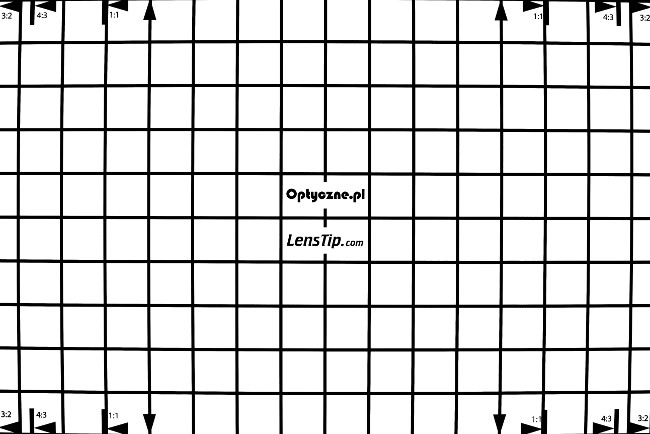
A focal length of 26 mm already provides a fairly wide angle of view, while the lens itself has a relatively simple optical design, a compromise necessitated by its pancake construction. We therefore expected distortion correction to involve significant compromises. However, we were pleasantly surprised, as the measured results are by no means substantial. On an APS-C/DX sensor, the lens exhibits slight barrel distortion, which we measured at -1.10%. This increases to a moderate level of -2.30% when using a full-frame sensor. We therefore have no reason to complain in this respect.
It is also worth comparing these results with those of the competing Nikkor, which makes no attempt to correct distortion and produces a high value of -5.15% on a full-frame sensor, while offering a slightly narrower field of view of 79 degrees.
| Sony A7R IIIa, 26 mm, APS-C/DX | |||
 |
|||
| Sony A7R IIIa, 26 mm, FF | |||
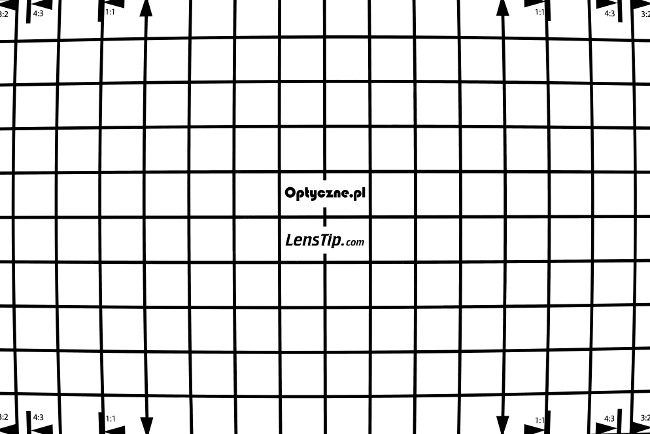 |
|||