Sony FE 200-600 mm f/5.6-6.3 G OSS
4. Image resolution
This standard formula, repeated in all our tests, describes well lenses up to a focal length of about 200 mm inclusive. For longer instruments we have to modify it a bit and we described our reasons in more detail in the Sigma S 500 mm f/5.6 DG DN OS test.
Let's remind here that lenses which apertures start near f/5.6-6.3 can't break any resolution records because of diffraction. By f/5.6 the diffraction limit reaches a value of 73-75 lpmm and it is the highest resolution such instruments can achieve. As no real lens is able to perform in its diffraction limit up from the maximum relative aperture, the diffraction limit by f/8.0 seems to be an even better benchmark – it amounts to 63-65 lpmm. The f/11.0 aperture is also a good choice with results of 51-52 lpmm.
Please Support UsIf you enjoy our reviews and articles, and you want us to continue our work please, support our website by donating through PayPal. The funds are going to be used for paying our editorial team, renting servers, and equipping our testing studio; only that way we will be able to continue providing you interesting content for free. |
- - - - - - - - - - - - - - - - - - - - - - - - - - - - - - - - - - - - - - - - - - - - - - - -
Let's check how the performance of the Sony FE 200-600 f/5.6-6.3 G OSS compares here. Its results in the frame centre at 200, 400, and 600 mm focal length presents a graph below.
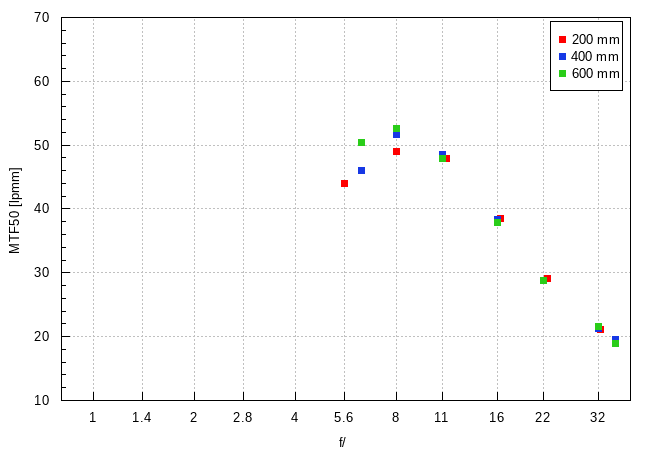
At first glance this graph is nothing that can whip up your enthusiasm. After all the Tamron 150-500 mm f/5-6.7 Di III VC VXD, tested by us not so long ago and praised, could reach results of even 58-59 lpmm and it is an instrument noticeably cheaper. Compared to that, the maximum results of the Sony, 52-53 lpmm, might seem a tad too low.
Still, if you look closer at this, our assessment of the Sony might be much higher. Firstly, the aforementioned results, reaching 58-59 lpmm, the Tamron got in the 150-300 mm focal range where it is faster than the Sony so it was much easier to achieve that much. Secondly, the Tamron was optimized to perform better at the shorter end of the focal spectrum where it is easier to achieve higher MTFs, and the weakest results showed at the maximum focal length. The Sony approached the topic in a different way. They emphasize the performance at the longest focal length, a very sensible move when it comes to this type of lens. The results of the Sony at 600 mm are better than the results of the Tamron at 500 mm. Thirdly, the Tamron is newer than the Sony; accordingly its constructors had more time to draw proper conclusions and learn from mistakes of others.
To sum up the performance of the Sony FE 200-600 f/5.6-6.3 G OSS in the frame centre doesn't provide you any reasons to complain. Already at the maximum relative aperture you deal with a resolution on a good level, no matter what focal length you employ. A slight stopping down of the lens improves these values even further. Additionally, the highest MTFs you can reach at the longest focal lengths, so at a place where they are needed the most often. As you see the Sony 200-600 mm will give you the most satisfaction at the longer end.
Let's glance at the performance on the edge of the APS-C sensor – an appropriate graph you can find below.
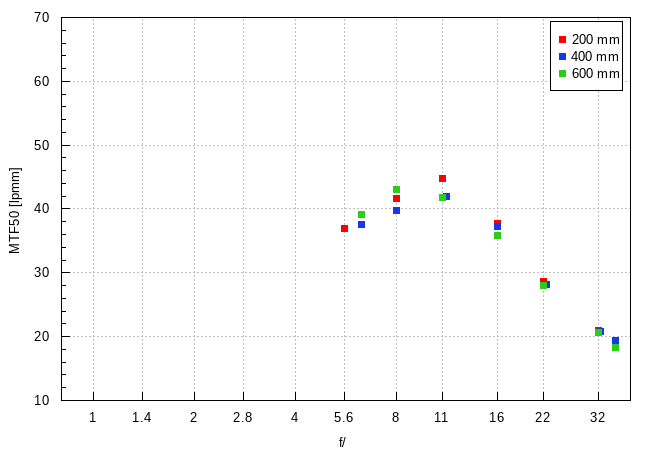
In this case the area near the maximum relative aperture provides results a tad below 40 lpmm. For such long focal lengths the effective MTFs are always lower than for typical lenses so in this case you can say the lens reaches te decency level. Of course the results don't blow you over because the Sony doesn't approach a level of 50 lpmm at any focal length. The cheaper Tamron 150-500 mm didn't have the slightest problems to exceed this value at shorter focal lengths and at 500 mm it reached 45-46 lpmm so we think its performance is significantly better.
Now let's check how the Sony 200-600 mm fares on the edge of full frame.
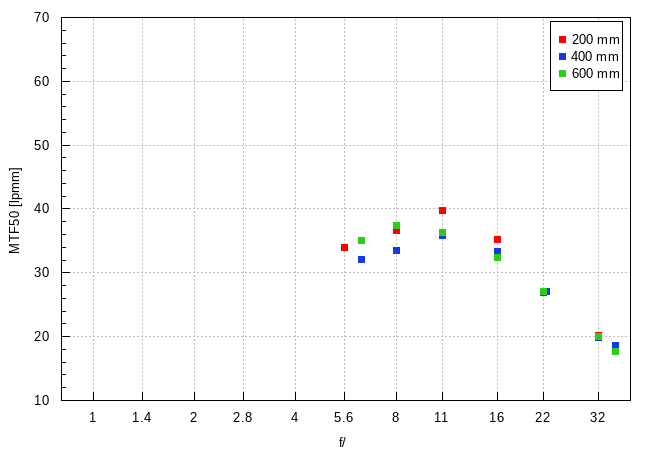
Here you have definitely more reasons to complain – practically all results are below 40 lpmm. Once again the Sony fares here distinctly weaker than the cheaper Tamron 150 – 500 mm. In his defence you can say that in most of cases MTFs are near the decency level and correction of edges of a lens with a closed construction is definitely more difficult than the correction of a lens that changes its dimensions.
To sum up the Sony FE 200-600 mm f/5.6-6.3 G OSS is a lens that is able to provide you surprisingly good results in the frame centre, especially at the maximum aperture. Mind you it is a lens hidden in a closed, sensibly compact barrel. Still, a compromise that happens on the edge of the full frame is a price you have to pay for this.
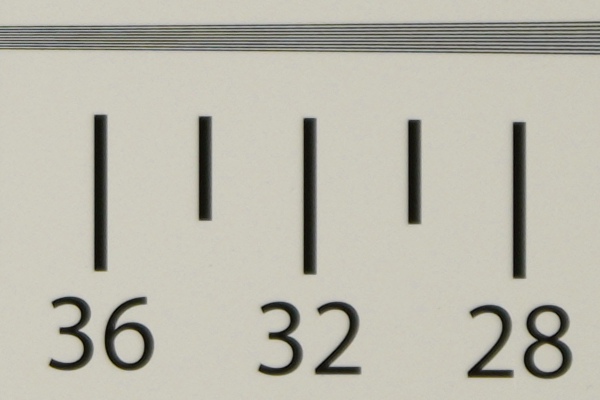
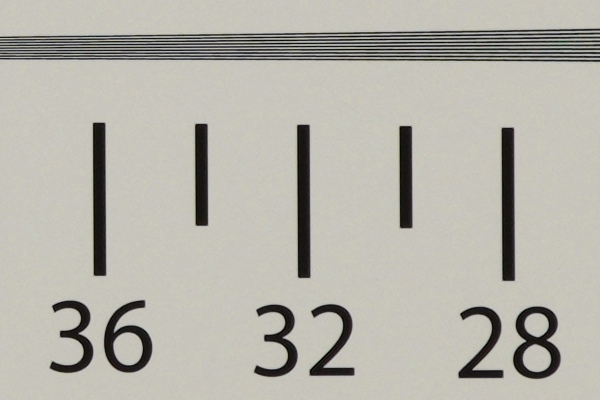
At the end of this chapter, traditionally, we present crops taken from photos of our resolution chart; they were taken from JPEG files saved along RAW files we used for the analysis above.
| A7R IIIa, JPEG, 200 mm, f/5.6 |
 |
| A7R IIIa, JPEG, 600 mm, f/8.0 |
 |