Sony FE 200-600 mm f/5.6-6.3 G OSS
8. Vignetting
| A7R IIIa, APS-C, JPEG, 200 mm, f/5.6 | A7R IIIa, APS-C, JPEG, 200 mm, f/8.0 |

|

|
| A7R IIIa, APS-C, JPEG, 300 mm, f/5.6 | A7R IIIa, APS-C, JPEG, 300 mm, f/8.0 |

|

|
| A7R IIIa, APS-C, JPEG, 400 mm, f/6.3 | A7R IIIa, APS-C, JPEG, 400 mm, f/8.0 |

|

|
| A7R IIIa, APS-C, JPEG, 600 mm, f/6.3 | A7R IIIa, APS-C, JPEG, 600 mm, f/8.0 |

|

|
In case of the smaller detector the problems can be called negligible. At the 200 mm focal length and the maximum relative aperture brightness loss in frame corners is just 18% (-0.59 EV) and it decreases to an imperceptible level of 3% (-0.10 EV), on stopping down the aperture to f/8.0.
Please Support UsIf you enjoy our reviews and articles, and you want us to continue our work please, support our website by donating through PayPal. The funds are going to be used for paying our editorial team, renting servers, and equipping our testing studio; only that way we will be able to continue providing you interesting content for free. |
- - - - - - - - - - - - - - - - - - - - - - - - - - - - - - - - - - - - - - - - - - - - - - - -
A very similar performance can be observed at the 300 mm focal length. By f/5.6 the vignetting amounts to 15% (-0.46 EV) and it decreases to 4% (-0.12 EV) after applying the f/8.0 aperture.
At the 400 mm the situation doesn't change much. At the maximum relative aperture, f/6.3 in this case, vignetting reaches 13% (-0.39 EV) and it drops to 3% (-0.09 EV), when you stop down the aperture to f/8.0.
Officially the highest vignetting level you observe at the 600 mm focal length but even then the values are low. By f/6.3 this aberration reaches 19% (-0.60 EV) and it decreases to just 8% (-0.23 EV) after applying f/8.0.
What about the full frame? Appropriate thumbnails are presented below.
| A7R IIIa, FF, JPEG, 200 mm, f/5.6 | A7R IIIa, FF, JPEG, 200 mm, f/8.0 |

|

|
| A7R IIIa, FF, JPEG, 300 mm, f/5.6 | A7R IIIa, FF, JPEG, 300 mm, f/8.0 |

|

|
| A7R IIIa, FF, JPEG, 400 mm, f/6.3 | A7R IIIa, FF, JPEG, 400 mm, f/8.0 |

|

|
| A7R IIIa, FF, JPEG, 600 mm, f/6.3 | A7R IIIa, FF, JPEG, 600 mm, f/8.0 |

|

|
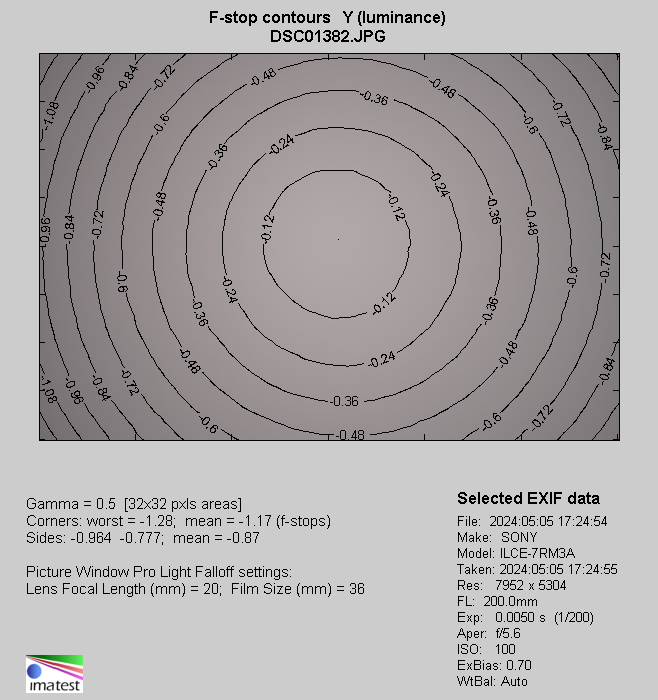
In case of the bigger detector the problems are more accented but still they can't be considered serious slip-ups. At the combination of the 200 mm focal length and the f/5.6 aperture vignetting amounts to 33% (-1.17 EV) and it decreases to 14% (-0.44 EV) after applying f/8.0. The stopping down of an additional 1 EV is able to reduce this aberration to a level of 6% (-0.19 EV) which we call imperceptible.
At the 300 mm focal length there are even less problems. At the maximum relative aperture vignetting is 30% (-1.03 EV) and it decreases to 15% (-0.47 EV) on stopping down the aperture to f/8.0. By f/11.0 the problem reaches just 7% (-0.21 EV) so is simply marginalized.
At the maximum focal lengths you notice the increase of vignetting. At 400 mm and f/6.3 the brightness loss in frame corners reaches 34% (-1.19 EV). Fortunately it decreases to 18% (-0.58 EV) by f/8.0 and to just 6% (-0.18 EV) by f/11.0.
At the 600 mm focal length and by f/6.3 this aberration gets to its highest level of 44% (-1.65 EV). By f/8.0 it decreases to 27% (-0.92 EV), and by f/11.0 it becomes practically imperceptible, reaching just 10% (-0.32 EV).
In this category the Sony prevails in the duel with the Tamron 150-500 because the maximum vignetting levels of the Tamron changed from 47% to 45% with the increase of the focal length from the minimum to the maximum one.
| Sony A7R IIIa, 200 mm, JPEG, f/5.6 |
 |
| Sony A7R IIIa, 300 mm, JPEG, f/5.6 |
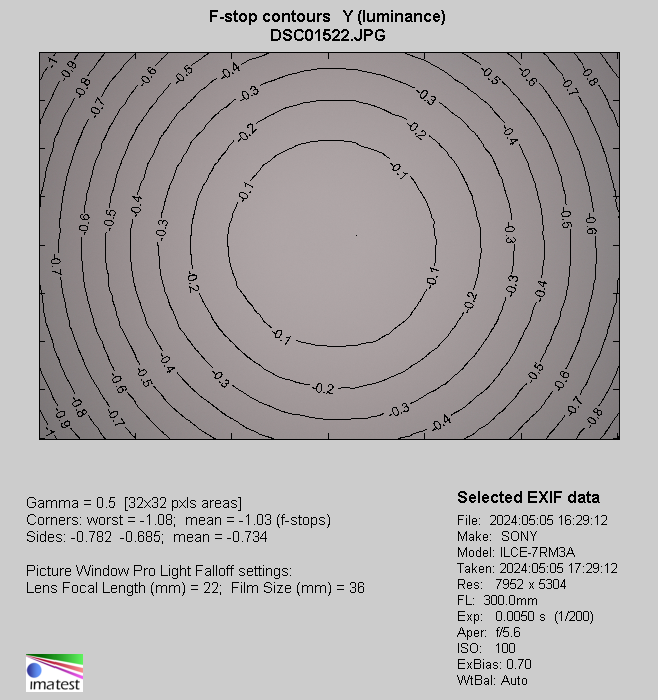 |
| Sony A7R IIIa, 400 mm, JPEG, f/6.3 |
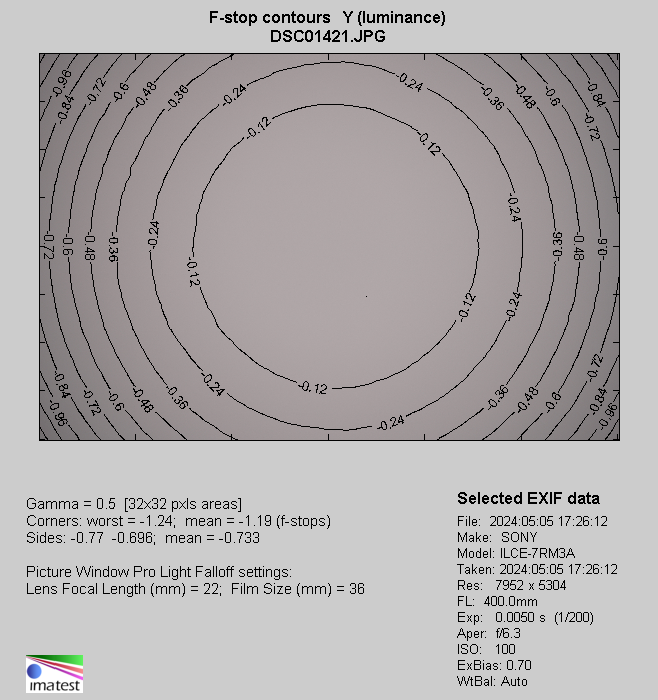 |
| Sony A7R IIIa, 600 mm, JPEG, f/6.3 |
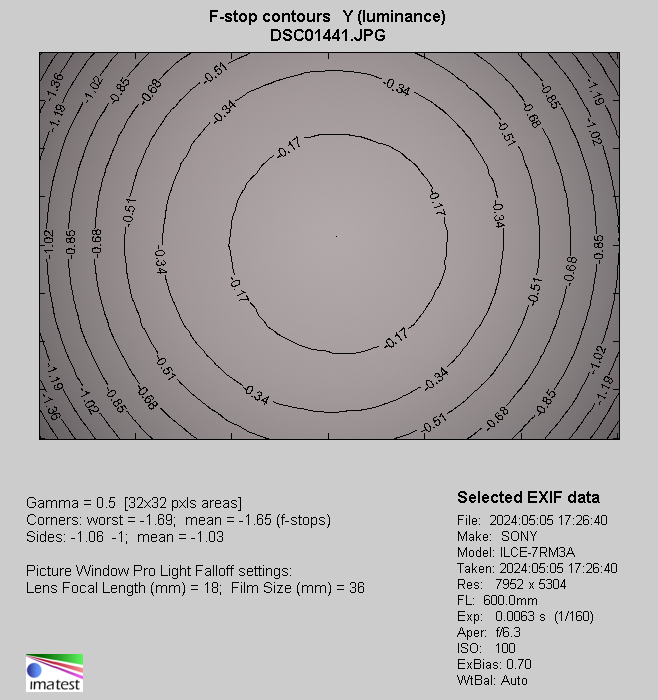 |