Nikon Nikkor Z 180-600 mm f/5.6-6.3 VR
3. Build quality and image stabilization
In the photo below the Nikkor Z 180-600 mm f/5.6-6.3 VR is positioned between the Sony FE 200-600 mm f/5.6-6.3 G OSS, and the Nikkor Z 24-70 mm f/4.0 S.
 |
Please Support UsIf you enjoy our reviews and articles, and you want us to continue our work please, support our website by donating through PayPal. The funds are going to be used for paying our editorial team, renting servers, and equipping our testing studio; only that way we will be able to continue providing you interesting content for free. |
- - - - - - - - - - - - - - - - - - - - - - - - - - - - - - - - - - - - - - - - - - - - - - - -
 |
On the slightly enlargened part of this ring there is a place for attaching a dedicated metal tripod adapter with the help of a special clamp. The adapter can be completely removed and that move allows you to deduct 185 grams – the lens without the adapter and caps weighs 1960 grams.
 |
Further on you see a manual focus ring 17 mm wide, completely covered by rubber ribs. It is a focus-by-wire mechanism without any distance or DOF scale. It moves smoothly and its focus throw amounts to an angle of about 270 degrees, providing you turn it quite vigorously. When your movements are slower the range increases to near 600 deg. Such values allow you very precise settings.
 |
Then you see an immobile part of the casing with an L-Fn2 function button and three others buttons without any inscription that are used to lock the autofocus in place.
 |
The front element is relatively flat, 93 mm in diameter, and it doesn't move. It is surrounded by a non-rotating filter thread, 95 mm in diameter, and a hood mount for a hood that is added to the accessory kit.
 |
Producers boast of the fact that the lens is completely weather-sealed – rubber gaskets protect all movable elements against dust, dirt, and humidity. Nikon's protective fluorine coating is supposed to make cleaning of the front element easier.
Buyers get in the box: both caps, a tripod adapter, a hood and a soft pouch. I admit at this price point we would expect a solid, hard case – the pouch is rather like a piece of cloth and I don't think it can protect the lens against anything at all.
 |
Image stabilization
The producers declare that the stabilization of the Nikkor 180-600 mm is as efficient as even 5.5 EV. We decided to check that claim and, in order to do so we took several dozen photos at 600 mm with exposure times ranging from 1/800 to 1/5 of a second and the stabilization switched on and off. For every set of photos we determined a percentage of out-of-focus shots; then we presented it in a form of a graph of exposure time which was expressed in EV (with 0 EV being an equivalent of 1/640 of a second).
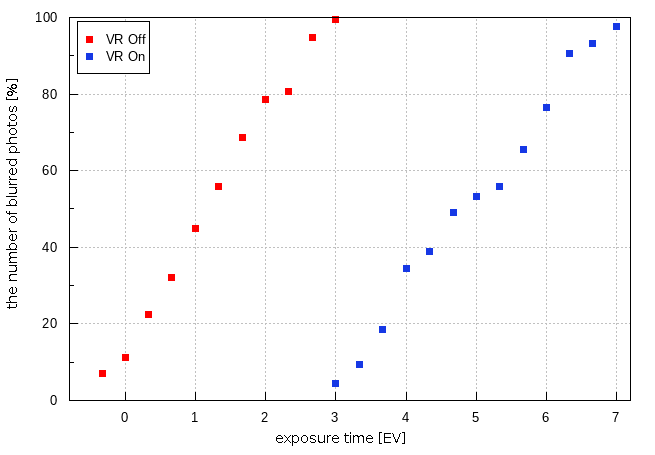
The maximum distance between both curves indeed reaches 4.3 EV and such is, in our view, the real efficiency of the stabilization mechanism of the tested lens. It is an excellent result that allows you to use the lens even in weak lighting conditions but it's short of these declared 5.5 EV.