Nikon Nikkor Z 180-600 mm f/5.6-6.3 VR
4. Image resolution
Like in case of other telephoto lenses, tested by us not so long ago, such as the Sigma S 500 mm f/5.6 DG DN OS, the Nikkor Z 400 mm f/4.5 VR S, and the Sony FE 200-600 mm f/5.6-6.3 G OSS, we have to describe the problem with maximum results of telephoto lenses as fast as f/5.6-6.3 in more detail. Why? It is obvious that the passage above concerning resolution records doesn't fit the tested instrument because these records are achieved by fast lenses stopped down to f/2.8-4.0. The tested Nikkor is simply not that fast so you cannot expect here results reached by lenses of 80 lpmm class or even anything close to that level.
In fact the diffraction limit by f/8.0 is the absolute maximum value you can count on. Trusting that fixed focal length f/1.2-1.8 lenses stopped down by about 4 EV, so exactly to f/8.0, work in their diffraction limit or as close to it as possible, you can say its value reaches near 66-68 lpmm. In case of 400-600 mm telephoto lenses, where it is easier to get distortions connected to micro-vibrations or mass of air that divide us from the testing chart, it's always safer to adopt the lower limit so values near 66 lpmm. This value exactly will be a good benchmark in our test.
Please Support UsIf you enjoy our reviews and articles, and you want us to continue our work please, support our website by donating through PayPal. The funds are going to be used for paying our editorial team, renting servers, and equipping our testing studio; only that way we will be able to continue providing you interesting content for free. |
- - - - - - - - - - - - - - - - - - - - - - - - - - - - - - - - - - - - - - - - - - - - - - - -
Being aware of all these issues now we can have a look at the results of the Nikkor Z 180-600 mm f/5.6-6.3 VR. First let's deal with the frame centre – an appropriate graph you can find below.
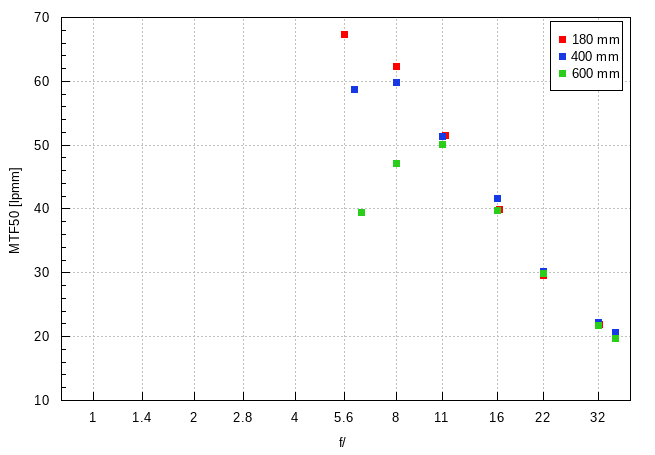
The performance at the 180 mm focal length is a very nice surprise. Already at the maximum relative aperture the lens is able to exceed 67 lpmm so we land even 1 lpmm above the limit, mentioned a moment ago. We should also remember two things: firstly, the 180 mm focal length exactly has the best aperture so it's easier to get higher results here. Secondly, the lens is designed in such a way that the shortest focal length is corrected the best.
The performance in the middle of the focal range can be described in very positive words as well. Here, at the maximum relative aperture, you deal with a good value of almost 59 lpmm, that increases to almost 60 lpmm on slight stopping down the lens. It is a much better result that in case of the Sony 200-600 mm that was able to reach merely 52 lpmm.
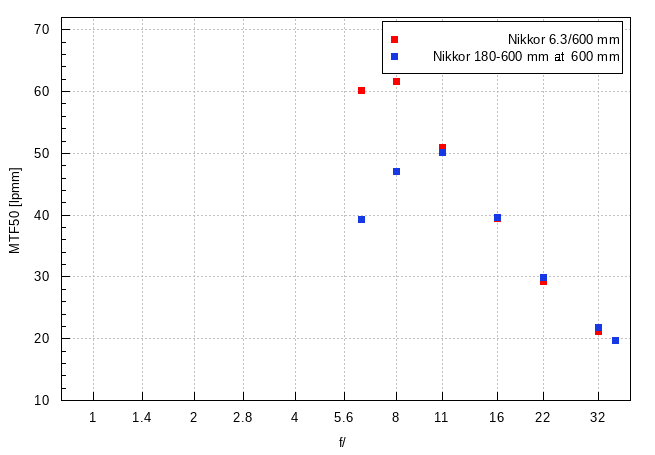
The longest focal length is, unfortunately, the weakest point of the Nikkor 180-600 mm. It seems Nikon followed a different path than Sony as in case of their instrument we observed a distinct improvement of the performance with increase of the focal length. The result is such that at the maximum relative aperture the Nikkor 180-600 mm provides merely decent images, and by f/8.0 you get a result of over 47 lpmm. It perhaps won't bowl you over but will allow you to reach images of good quality. Of course this performance is noticeably weaker than in case of the Sony model that was able to exceed 50 lpmm up from the maximum relative aperture.
We would like to show also that at the 600 mm focal length the tested Nikkor lags behind the much more expensive fixed-focal model so the Nikkor Z 600 mm f/6.3 VR. We present the comparison in a form of a graph below.
Now let's check how the Nikkor Z 180-600 mm f/5.6-6.3 VR performs on the edge of the APS-C/DX sensor.
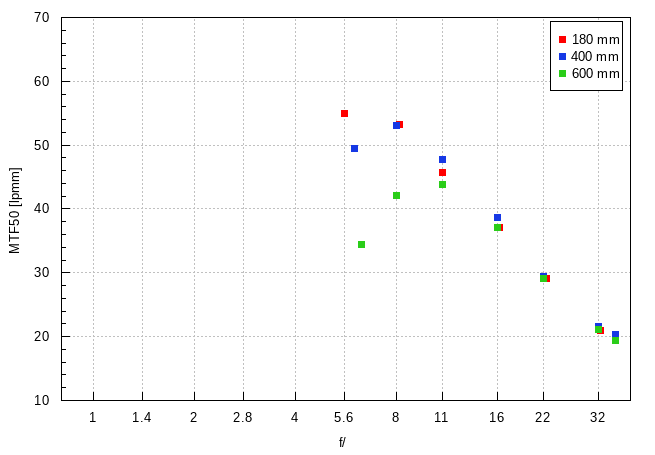
Once again the 180 mm focal length is the best but the middle of the range is only a tad weaker. In both cases you deal with good result up from the maximum relative aperture. Noticeably more serious problems you can observe at 600 mm where the lens should be closed down to near f/7.1-8.0 in order to produce images of sensible quality.
The next graph presents the performance of the Nikkor 180-600 mm on the edge of full frame.
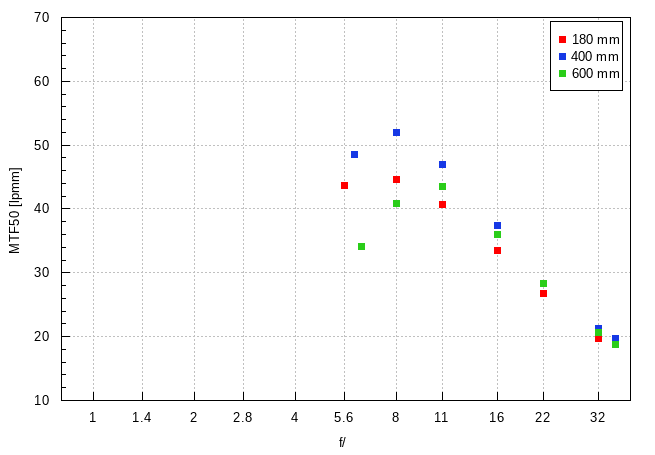
And here a small surprise awaits you – the middle of the focal range takes the lead. The 180 mm focal length fares a bit weaker and the 600 mm is the weakest as you have to close the lens down to near f/8.0 in order to enjoy images of good quality.
To sum up, the Nikkor Z 180-600 mm f/5.6-6.3 VR showed a really excellent performance in the 180-400 mm range but it had to pay for it wit the maximum focal length. I really doubt it was such a clever idea. Personally, I would rather see these several lpmm more at the maximum focal length and a bit weaker results at 180 mm.
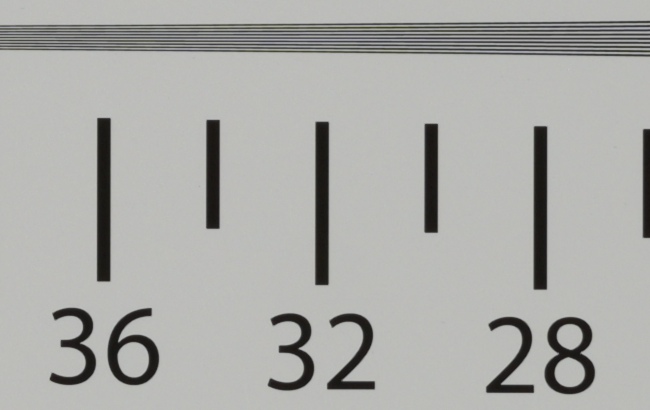
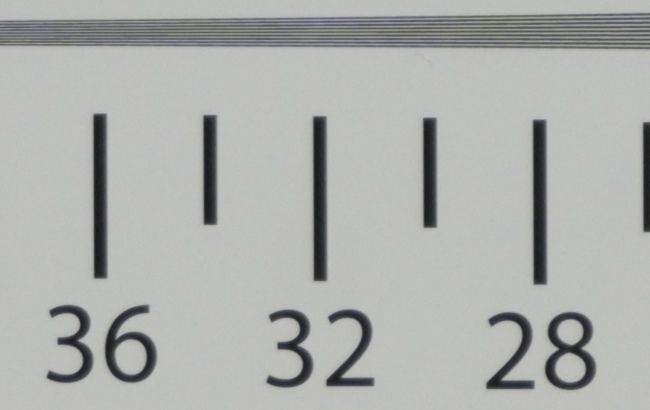
At the end of this chapter, traditionally, we present crops taken from photos of our resolution chart; they were taken from JPEG files saved along RAW files we used for the analysis above.
| Nikon Z7, JPEG, 180 mm, f/5.6 |
 |
| Nikon Z7, JPEG, 600 mm, f/6.3 |
 |