Nikon Nikkor Z 180-600 mm f/5.6-6.3 VR
8. Vignetting
| Nikon Z7, APS-C/DX, JPEG, 180 mm, f/5.6 | Nikon Z7, APS-C/DX, JPEG, 180 mm, f/8.0 |

|

|
| Nikon Z7, APS-C/DX, JPEG, 400 mm, f/6.0 | Nikon Z7, APS-C/DX, JPEG, 400 mm, f/8.0 |

|

|
| Nikon Z7, APS-C/DX, JPEG, 600 mm, f/6.3 | Nikon Z7, APS-C/DX, JPEG, 600 mm, f/8.0 |

|

|
In case of the smaller sensor the problems are completely negligible. At 180 mm and the maximum relative aperture the brightness loss in frame corners is completely imperceptible, amounting to just 3% (-0.09 EV). Very similar results you can observe at 400 mm – in its case at the maximum relative aperture that amounts to already f/6.0 vignetting reaches only 4% (-0.12 EV).
Please Support UsIf you enjoy our reviews and articles, and you want us to continue our work please, support our website by donating through PayPal. The funds are going to be used for paying our editorial team, renting servers, and equipping our testing studio; only that way we will be able to continue providing you interesting content for free. |
- - - - - - - - - - - - - - - - - - - - - - - - - - - - - - - - - - - - - - - - - - - - - - - -
Officially the highest level of vignetting can be observed at the 600 mm focal length but even there you deal with very small values. By f/6.3 this aberration reaches 13% (-0.41 EV) and it decreases to just 2% (-0.05 EV) after applying the f/8.0 aperture.
Now let's check the vignetting on full frame – appropriate thumbnails are presented below.
| Nikon Z7, FX, JPEG, 180 mm, f/5.6 | Nikon Z7, FX, JPEG, 180 mm, f/8.0 |

|

|
| Nikon Z7, FX, JPEG, 400 mm, f/6.0 | Nikon Z7, FX, JPEG, 400 mm, f/8.0 |

|

|
| Nikon Z7, FX, JPEG, 600 mm, f/6.3 | Nikon Z7, FX, JPEG, 600 mm, f/8.0 |

|

|
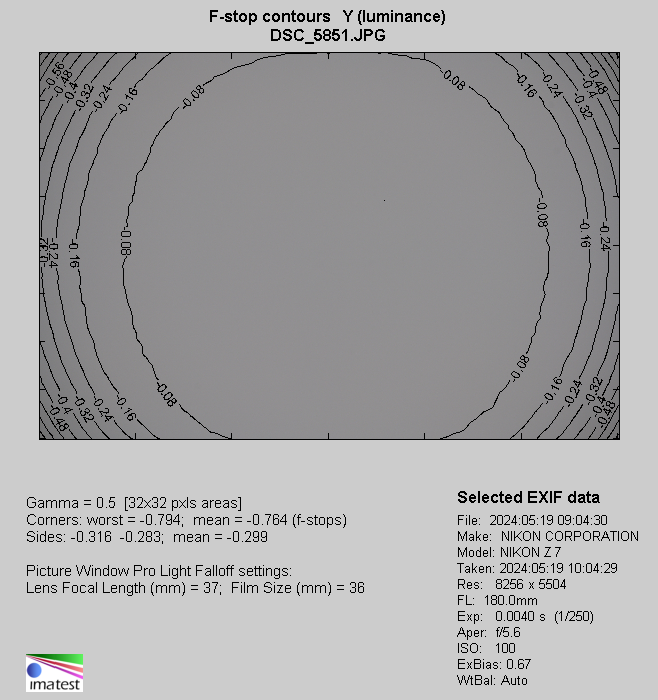
There are a bit more problems here but the overall performance of the Nikkor should only be praised. By 180 mm and by f/5.6 the light fall-off in the frame corners amounts to just 23% (-0.76 EV) and it decreases to 16% (-0.51 EV) on stopping down the aperture to f/8.0. By f/11.0 vignetting becomes practically imperceptible, reaching just 11% (-0.32 EV).
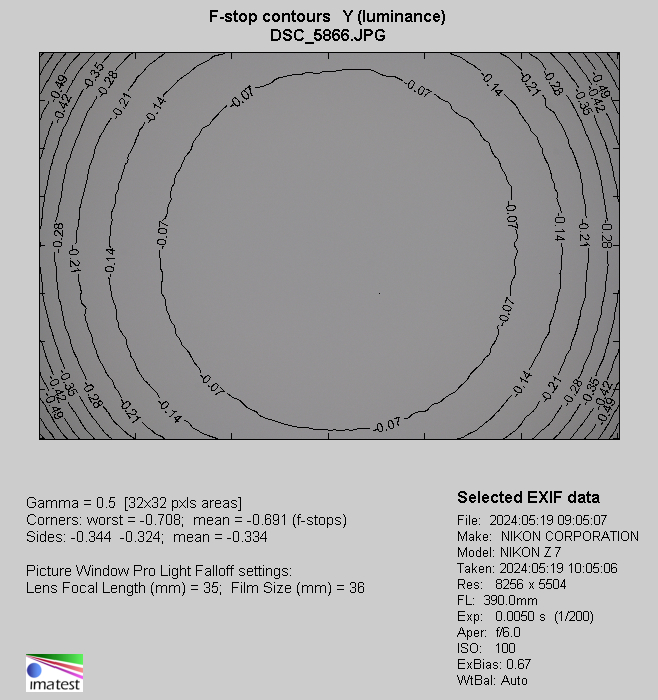
The performance in the middle of the focal range is even a tad better. By f/6.0 this aberration reaches 21% (-0.69 EV), by f/8.0 it drops to 11% (-0.33 EV). By f/11.0 all problems end completely because our result amounts to just 4% (-0.13 EV).
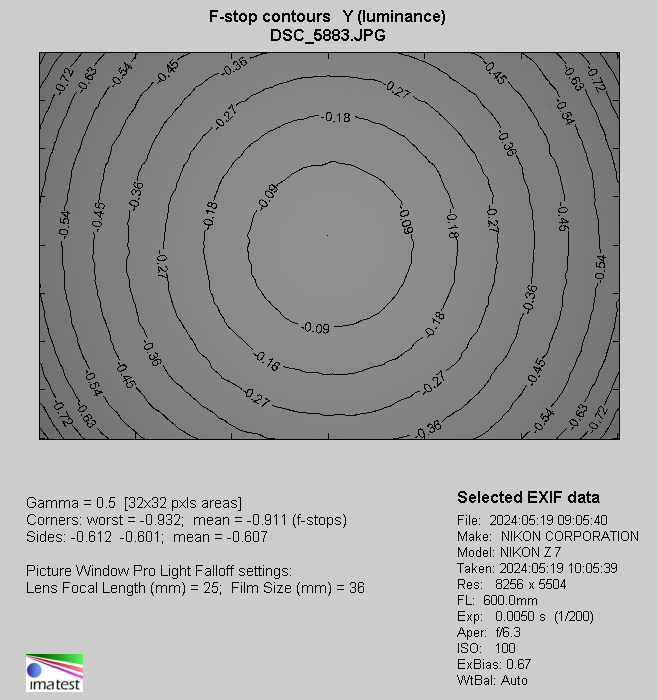
The biggest chances to notice vignetting you get at the maximum focal length where by f/6.3 it reaches only 27% (-0.91 EV) and by f/8.0 it decreases to 13% (-0.42 EV). By f/11.0 all problems end completely with a result of just 3% (-0.10 EV).
Nowadays it is very rare that a zoom lens designed for full frame mirrorless cameras doesn't show at any point vignetting higher than 1 EV. The Nikkor Z 180-600 mm f/5.6-6.3 VR is an exception to this rule. It deserves to be praised especially that, like in the case of distortion, it fares noticeably better than the Sony 200-600 mm and the Tamron 150-500 mm. A round of applause!
| Nikon Z7, 180 mm, JPEG, f/5.6 |
 |
| Nikon Z7, 400 mm, JPEG, f/6.0 |
 |
| Nikon Z7, 600 mm, JPEG, f/6.3 |
 |