Sony FE 400-800 mm f/6.3-8 G OSS
4. Image resolution
This standard formula, repeated in all our tests, describes well lenses up to a focal length of about 200 mm inclusive. For longer instruments we have to modify it a bit and we described our reasons in more detail in the Sigma S 500 mm f/5.6 DG DN OS lens review.
Let's remind here that lenses which apertures start near f/6.3-8.0 can't break any resolution records because of diffraction. By f/8.0 the diffraction limit reaches a value of 63-65 lpmm and it is the highest resolution such instruments can achieve. As no real lens is able to perform in its diffraction limit up from the area close to the maximum relative aperture, the diffraction limit by f/11.0 seems to be an even better benchmark – it amounts to 51-52 lpmm. It means that if the tested lens, near its maximum relative aperture and on slight stopping down, gets as high as near 50 lpmm or slightly exceeds that vaule we will be really satisfied with its performance.
Please Support UsIf you enjoy our reviews and articles, and you want us to continue our work please, support our website by donating through PayPal. The funds are going to be used for paying our editorial team, renting servers, and equipping our testing studio; only that way we will be able to continue providing you interesting content for free. |
- - - - - - - - - - - - - - - - - - - - - - - - - - - - - - - - - - - - - - - - - - - - - - - -
Let's check how the performance of the Sony FE 400-800 f/6.3-8 G OSS compares here. Its results in the frame centre at 400, 600, and 800 mm focal length presents a graph below.
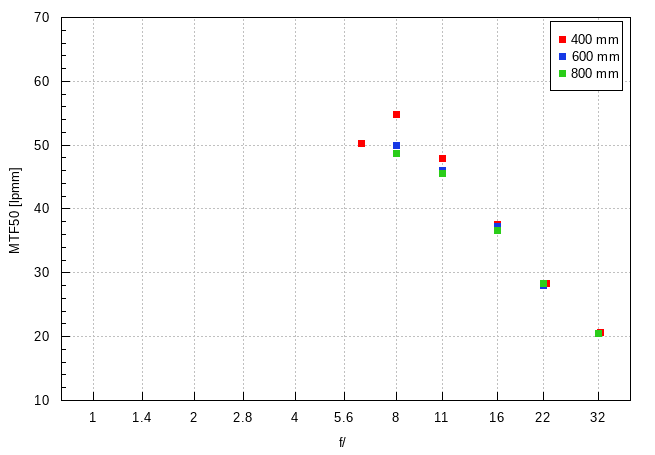
Compared to everything we mentioned a bit earlier, the results at the 400 mm focal length are really excellent. Already at the maximum relative aperture you exceed the level of 50 lpmm and on stopping down the aperture to f/8.0 the MTFs increase to almost 55 lpmm.
At 400 mm higher results were easier to reach because the tested lens is the fastest at this point. At 600 and 800 mm the maximum relative aperture amounts to f/8.0 and in both these cases the level of 50 lpmm is well within the reach of the margin of measuring errors. What's more the lens is the sharpest exactly in that place, because on stopping down the aperture to f/11.0 diffraction makes itself felt and the resolution decreases to near 46 lpmm. Still this performance allows you to produce images of very good quality in the most useful range of apertures.
The comparison between the performance of the new lens and the performance of the Sony FE 200-600 mm f/5.6 -6.3 G OSS is also interesting – the graph presented below shows is at the 400 mm focal length.
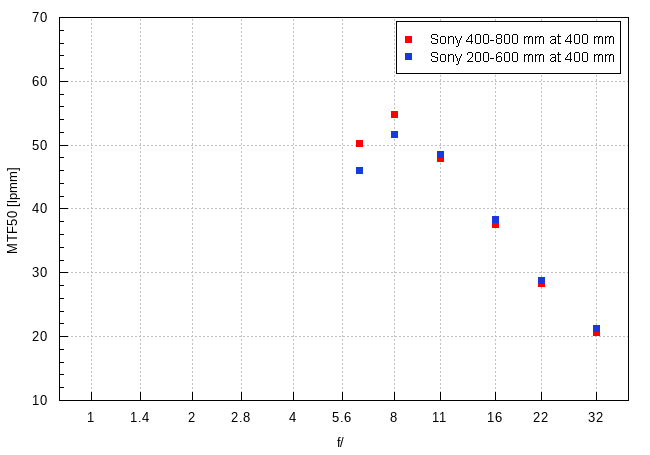
Both models feature here exactly the same light so the comparison is quite objective. The new and more expensive lens fares definitely better. Of course you should remember the fact that the Sony 200-600 mm improved its performance with the lengthening the focal length so a comparison at the 600 mm, presented below, is also an interesting thing to watch.
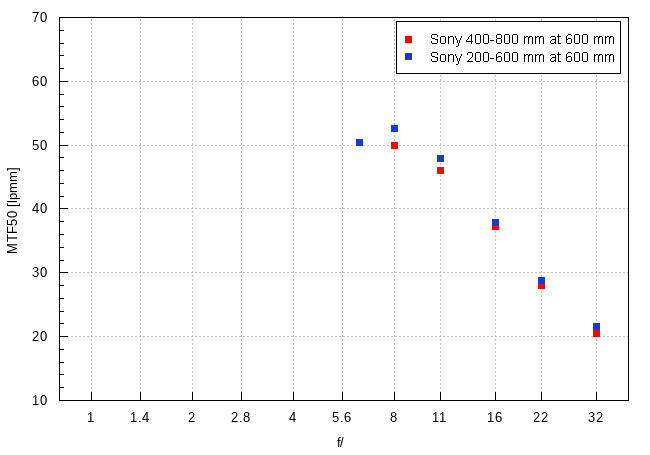
This time the Sony 200-600 mm prevails because of two factors. Firstly it's because of its surprisingly better aperture fastness at this focal length and then because it was optimized to perform the best at 600 mm exactly. The result? The older and cheaper model prevails here.
After the analysis concerning the performance of the Sony 400-800 mm in the frame centre it's time to look at the edge of the APS-C sensor and they are presented by a graph below.
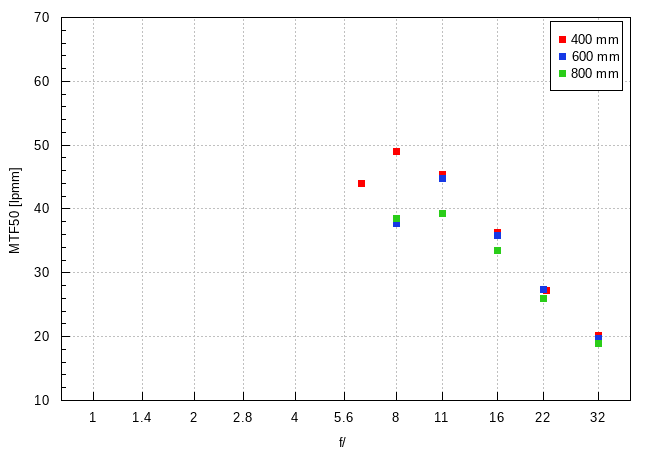
Once again the 400 mm focal length is the best here. In case of longer focal lengths the results are weaker, but even at the maximum relative aperture, within the margin of error, they are able to intertwine with the decency level. Overall there are no reasons to complain.
What about the more demanding edge of full frame? Let's check it out.
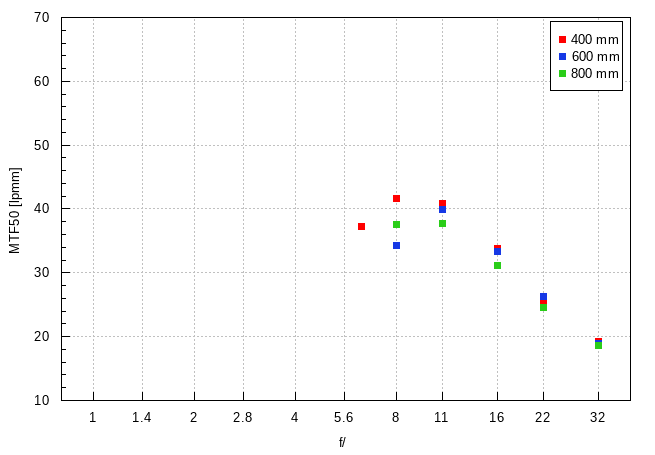
In this case, no matter what focal length we employ, the results at the maximum relative aperture leave a bit to be desired. If you want to get images of sensible quality you need to employ f/8.0 at 400 mm and f/11.0 at longer end of the focal spectrum.
The summary of this chapter can be only positive. Taking into account the offered aperture fastness the lens seems to pull up everything what is only possible off its parameters. Of course in ideal case you could perhaps obtain results by several lpmm higher but it would entail bigger physical dimensions and weight. In my opinion it is the price not worth paying.
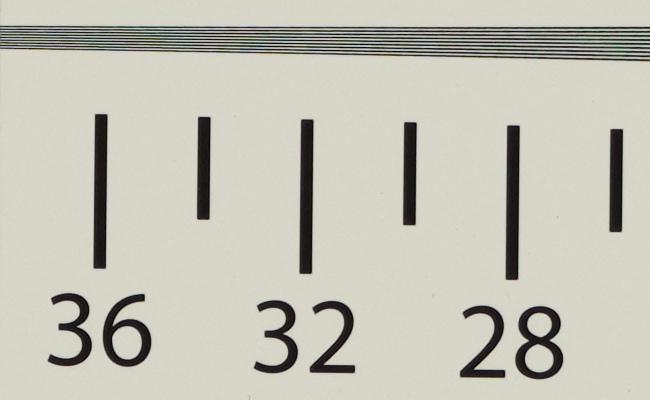
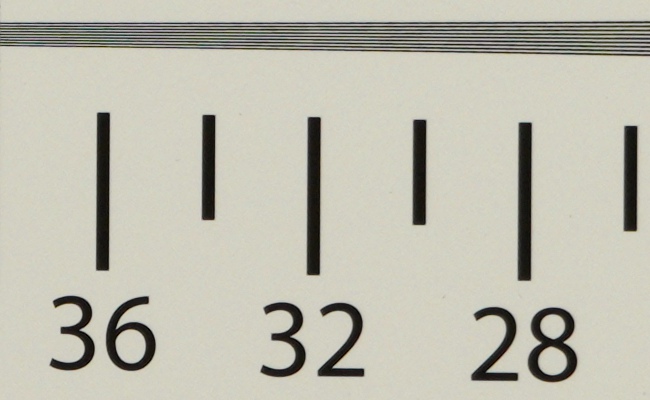
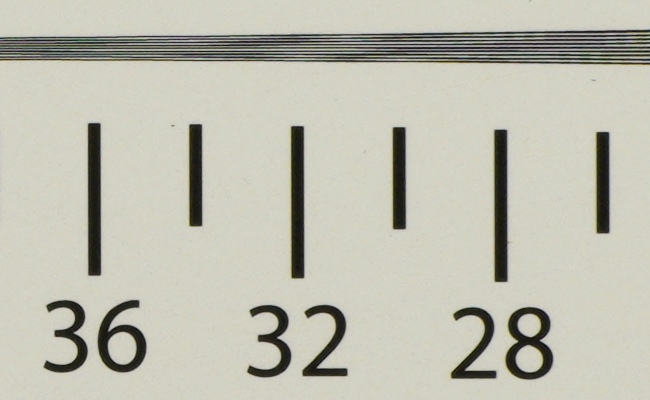
At the end of this chapter, traditionally, we present crops taken from photos of our resolution chart; they were taken from JPEG files saved along RAW files we used for the analysis above.
| A7R IIIa, JPEG, 400 mm, f/8.0 |
 |
| A7R IIIa, JPEG, 600 mm, f/8.0 |
 |
| A7R IIIa, JPEG, 800 mm, f/8.0 |
 |