Leica APO-Summicron-SL 75 mm f/2 ASPH.
4. Image resolution
We can also mention the fact that the decency level is positioned here near 40-42 lpmm, the best system primes should reach about 80 lpmm and the record-breakers might go as high as near 85 lpmm or even slightly exceed this value. Of course as we add more and more tests of lenses from this system to our database we might refine these estimations even further.
Now let's check how the performance of the Leica APO-Summicron SL 75 mm f/2 ASPH compares – its results in the frame centre, on the edge of the APS-C sensor and on the edge of full frame presents a graph below.
Please Support UsIf you enjoy our reviews and articles, and you want us to continue our work please, support our website by donating through PayPal. The funds are going to be used for paying our editorial team, renting servers, and equipping our testing studio; only that way we will be able to continue providing you interesting content for free. |
- - - - - - - - - - - - - - - - - - - - - - - - - - - - - - - - - - - - - - - - - - - - - - - -
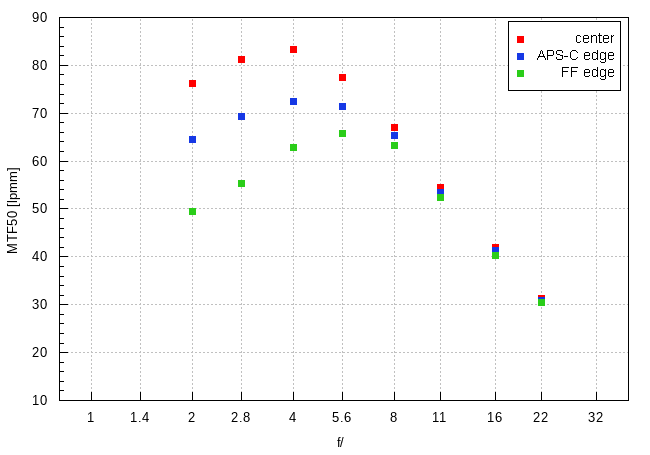
When it comes to the frame centre, the values, presented here, are simply excellent, with two things that we find especially impressing. Firstly, an outstanding performance at the maximum relative aperture, with a level of over 76 lpmm. It's worth reminding here that the faster Panasonic S Pro 1.4/50 at this particular aperture was by more than a dozen lpmm weaker, a huge difference indeed. Secondly, by f/4.0 you observe a level very close to record-breaking values, reaching as high as 83.4 +\- 0.4 lpmm. So high results are usually limited to just very fast f/1.2-1.4 lenses and only the best of them are able to approach such levels.
In order not to make unfounded claims we present a comparison between the Leica, tested here, the Voigtlander Apo-Lanthar 2/65, and the Sigma C 65 mm f/2 DG DN. Both these models were listed by us as record-breakers of the Sony FE system for a long time so the bar is set really high here.
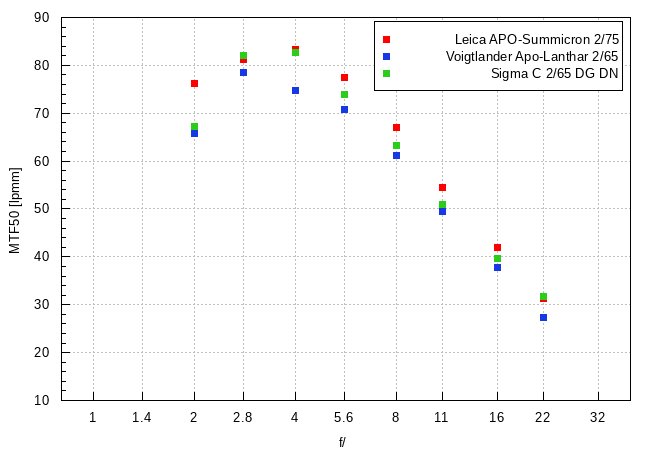
Once again it is clear that the APO-Summicron is really good at its maximum relative aperture, outstripping the rivals in a noticeable way. The Sigma, more optically complex that the Leica, is able to compete with the tested lens on equal terms only up from f/2.8. The Voigtlander has to be satisfied with the third place.
When it comes to the edge of the APS-C sensor the Leica APO-Summicron-SL 75 mm f/2 ASPH. once again should be praised. Already by f/2 you get a very good value, amounting to almost 65 lpmm; on stopping down the lens to near f/4.0-5.6 it improves reaching an excellent level of over 70 lpmm. Many lenses, tested by us so far, weren't able to get such results even in the frame centre.
The edge of the full frame is corrected in a proper way – even at the maximum relative aperture we got a good value of almost 50 lpmm, on stopping down the lens improved its performance to near 65 lpmm. Still, we are left a tad unsatisfied. After all the lens doesn't have to cover very wide angles of view, its aperture fastness is not exceptionally high, and it is a significantly big, heavy and expensive instrument, designed by a very renowned and experienced producer. I admit in such a case you should expect smaller differences between the frame centre and its edges. Of course, you might also call it pushing where there is nothing to push – the tested model is going to be used the most often by f/2.0 and f/2.8, with the photographed objects close to the frame centre so the edges will land in out-of-focus areas anyway. Whether you get over 50 lpmm or over 60 lpmm there is not that important.
To sum up, we don't doubt the Leica APO-Summicron SL 75 mm f/2 ASPH. is an outstanding lens, one of the sharpest L-mount models currently available.
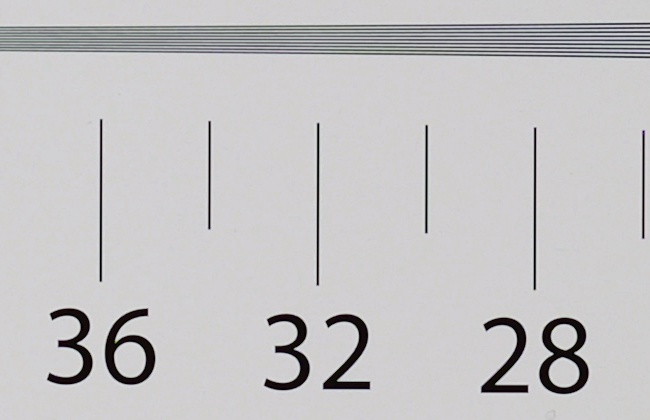
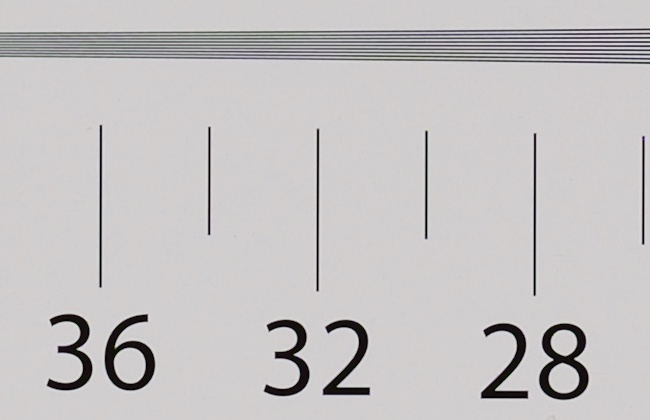
At the end of this chapter, traditionally, we present crops taken from photos of our resolution chart; they were taken from JPEG files saved along RAW files we used for the analysis above.
| Panasonic S1R II, JPEG, 75 mm, f/2.0 |
 |
| Panasonic S1R II, JPEG, 75 mm, f/4.0 |
 |