Leica APO-Summicron-SL 75 mm f/2 ASPH.
8. Vignetting
As you could notice in previous chapters the data obtained on the edge of the APS-C/DX sensor are left for resolution and chromatic aberration measurements. In these cases it was important because it provides additional piece of information about the layout of sharpness and chromatic aberration across the whole analysed frame.
First let's deal with vignetting observed for uncorrected JPEG files.
Please Support UsIf you enjoy our reviews and articles, and you want us to continue our work please, support our website by donating through PayPal. The funds are going to be used for paying our editorial team, renting servers, and equipping our testing studio; only that way we will be able to continue providing you interesting content for free. |
- - - - - - - - - - - - - - - - - - - - - - - - - - - - - - - - - - - - - - - - - - - - - - - -
| S1R II, FF, JPEG, f/2.0 | S1R II, FF, JPEG, f/2.8 |

|

|
| S1R II, FF, JPEG, f/4.0 | S1R II, FF, JPEG, f/5.6 |

|

|
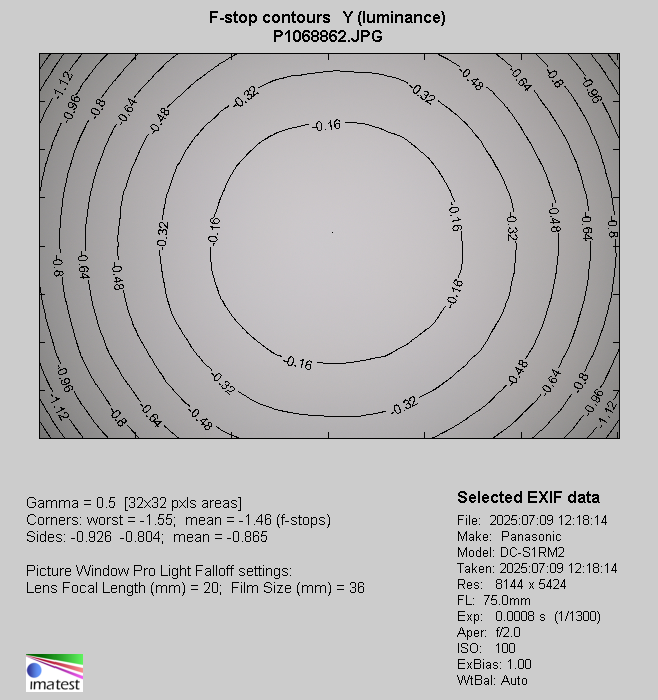
Huge dimensions of Leica allow it to produce a quite sensible performance in this category. At the maximum relative aperture the brightness loss in the very corner of the frame amounts to 40% (-1.46 EV). This result still fits a range of moderate values although I admit it is very close to its borderline. The fact that vignetting drops very quickly on stopping down also should be praised. By f/2.8 you deal with a small value of 22% (-0.72 EV) and by f/4.0 and f/5.6 this aberration becomes practically completely imperceptible, with results of 10% (-0.30 EV) and 4% (-0.13 EV) respectively.
As a kind of a bonus we would like to present vignetting results for uncorrected RAW files that provide you a tad wider field of view than JPEGs.
| S1R II, FF, RAW, f/2.0 | S1R II, FF, RAW, f/2.8 |

|

|
| S1R II, FF, RAW, f/4.0 | S1R II, FF, RAW, f/5.6 |

|

|
In this case at the maximum relative aperture the brightness loss in frame corners reaches 45% (-1.74 EV) and it decreases to 27% (-0.92 EV) on stopping down the aperture to f/2.8. Applying f/4.0 aperture makes this aberration decrease to a very slight value of 13% (-0.42 EV), and all problems end by f/5.6, where we got a result of just 6% (-0.18 EV).
| Panasonic S1R II, JPEG, 75 mm, f/2.0 |
 |