Sigma C 20-200 mm f/3.5-6.3 DG
4. Image resolution
Let's check how the Sigma C 20-200 mm f/3.5-6.3 DG performs – its results in the frame centre at 20,30, 50, 100, and 200 mm presents a graph below.
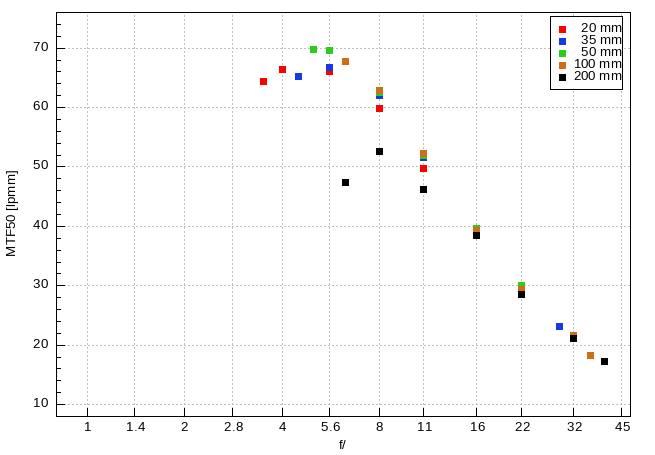
One thing should be said at once. You shouldn't expect any resolution records from a zoom lens that, in the majority of its range, is as fast as about f/5.0. Quite the opposite. Here achieving diffraction limit by f/8.0 is actually a huge achievement and in the case of the 42.4 Mpix Sony detector such a limit reaches about 63-68 lpmm.
Please Support UsIf you enjoy our reviews and articles, and you want us to continue our work please, support our website by donating through PayPal. The funds are going to be used for paying our editorial team, renting servers, and equipping our testing studio; only that way we will be able to continue providing you interesting content for free. |
- - - - - - - - - - - - - - - - - - - - - - - - - - - - - - - - - - - - - - - - - - - - - - - -
The fact that such a demanding construction doesn't have any problems with reaching or even exceeding such a limit for a wide range of focal lengths from 20 to 100 mm is actually a very nice surprise. Only when you start approaching the maximum focal length the results get distinctly weaker. Still even there at the maximum relative aperture you see images that are fully useful and, on slight stopping down the aperture you are able to exceed a quite good level of 50 lpmm.
In the frame centre the Sigma C 20-200 mm f/3.5-6.3 DG doesn't let you down. In fact it even fares exceedingly well.
Now let's check how the situation changes when you pass to the edge of the APS-C/DX sensor.
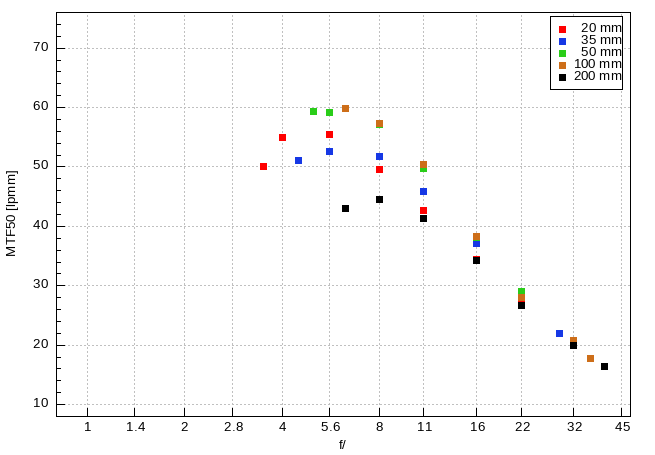
Here the results are a bit more different between particular focal lengths. The best performance you can observe at 50 and 100 mm where image quality is beyond reproach. The 20 mm focal length is close behind, as it is able to provide good results, reaching near 50 lpmm, up from the maximum relative aperture. The performance at 35 mm is positioned a tad lower but there you also get MTFs higher than 50 lpmm already up from f/4.5.
Once again the 200 mm is the weakest but even in its case you don't have any reasons to complain because at the maximum relative aperture you get a result of 43 lpmm so above the decency level.
Let's pass now to the description of the performance on the edge of full frame. An appropriate graph can be seen below.
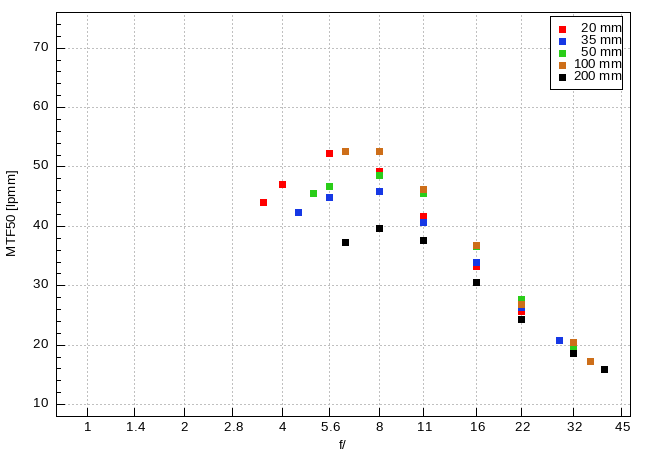
This time the ranking of focal lengths is changed because 20 and 100 mm focal lengths fare the best and their results are very similar. It is a very good piece of news. It means that in case of landscape and architecture photography, at the widest angle of view, the tested Sigma will provide images of good quality across the frame, no matter what aperture you employ.
There are no reservations concerning the performance at 35 and 50 mm where, up from the maximum relative aperture, the resolution is decent and improves on stopping down.
Once again the 200 mm focal length is the weakest. You can even call it the first weak spot of this part of our test. You are able to produce more or less decent images only if you take photos in close areas of f/8.0. As you move away from this aperture value image quality gets weaker and weaker. It is certainly a kind of compromise but, taking into account the scale of difficulty, it's nothing serious, not especially bothersome in real life uses of a lens of this type.
To sum up I am really positively surprised by the results presented by the tested Sigma in this category. I expected far more weak points and I got just one and not especially bothersome to boot.
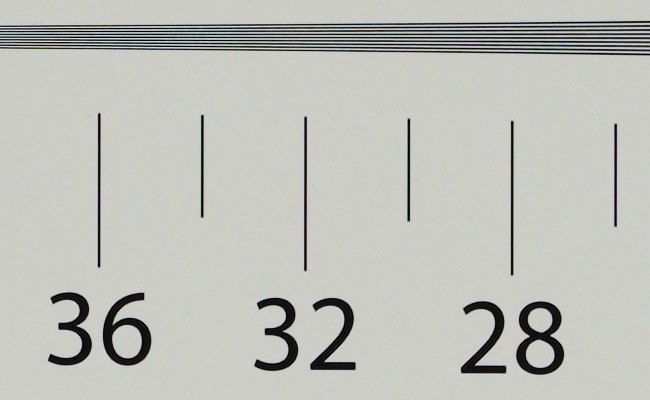
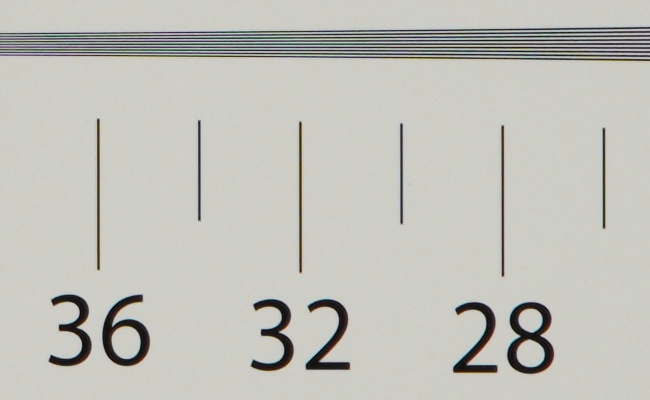
At the end of this chapter, traditionally, we present crops taken from photos of our resolution chart; they were taken from JPEG files saved along RAW files we used for the analysis above.
| A7R IIIa, JPEG, 50 mm, f/5.0 |
 |
| A7R IIIa, JPEG, 200 mm, f/6.3 |
 |