Sigma C 20-200 mm f/3.5-6.3 DG
8. Vignetting
| A7R IIIa, APS-C, JPEG, 20 mm, f/3.5 | A7R IIIa, APS-C, JPEG, 20 mm, f/4.0 |

|

|
| A7R IIIa, APS-C, JPEG, 35 mm, f/4.5 | A7R IIIa, APS-C, JPEG, 35 mm, f/5.6 |

|

|
| A7R IIIa, APS-C, JPEG, 50 mm, f/5.6 | A7R IIIa, APS-C, JPEG, 50 mm, f/8.0 |

|

|
| A7R IIIa, APS-C, JPEG, 100 mm, f/6.3 | A7R IIIa, APS-C, JPEG, 100 mm, f/8.0 |

|

|
| A7R IIIa, APS-C, JPEG, 200 mm, f/6.3 | A7R IIIa, APS-C, JPEG, 200 mm, f/8.0 |

|

|
At the 20 mm focal length vignetting is visible without creating a serious problem. At the maximum relative aperture it reaches 21% (-0.67 EV) and it decreases to 19% (-0.61 EV) on slight stopping down the aperture to f/4.0. By f/5.6 this aberration becomes almost imperceptible, reaching 13% (-0.41 EV) and it decreases by another percentage point after applying f/8.0.
Please Support UsIf you enjoy our reviews and articles, and you want us to continue our work please, support our website by donating through PayPal. The funds are going to be used for paying our editorial team, renting servers, and equipping our testing studio; only that way we will be able to continue providing you interesting content for free. |
- - - - - - - - - - - - - - - - - - - - - - - - - - - - - - - - - - - - - - - - - - - - - - - -
The wide middle of the focal range fares in this category exceedingly well. At 35 mm vignetting remains imperceptible even at the maximum relative aperture, amounting to just 8% (-0.25 EV). At 50 and 100 mm the situation is even better, with results of 6% (-0.17 EV) and 5% (-0.14 EV) respectively. A slight increase is visible only at the maximum focal length where by f/6.3 this aberration amounts to 17% (-0.55 EV) and it decreases to an imperceptible level of 10% (-0.29 EV) on stopping down the aperture to f/8.0.
The cooperation with the smaller APS-C/DX sensor in this testing category is very successful but let's check how the situation changes when you pass to full frame, Appropriate thumbnails for uncorrected JPEG files can be seen below.
| A7R IIIa, FF, JPEG, 20 mm, f/3.5 | A7R IIIa, FF, JPEG, 20 mm, f/4.0 |

|

|
| A7R IIIa, FF, JPEG, 35 mm, f/4.5 | A7R IIIa, FF, JPEG, 35 mm, f/5.6 |

|

|
| A7R IIIa, FF, JPEG, 50 mm, f/5.6 | A7R IIIa, FF, JPEG, 50 mm, f/8.0 |

|

|
| A7R IIIa, FF, JPEG, 100 mm, f/6.3 | A7R IIIa, FF, JPEG, 100 mm, f/8.0 |

|

|
| A7R IIIa, FF, JPEG, 200 mm, f/6.3 | A7R IIIa, FF, JPEG, 200 mm, f/8.0 |

|

|
If anybody hoped that the performance would be good, they were wrong. Of course it would be foolish to think that a lens with such a focal range and physical dimensions will have low vignetting levels; after all vignetting, next to distortion, is such a category where optics designers look for compromises. After all dark corners can be brightened with the help of software.
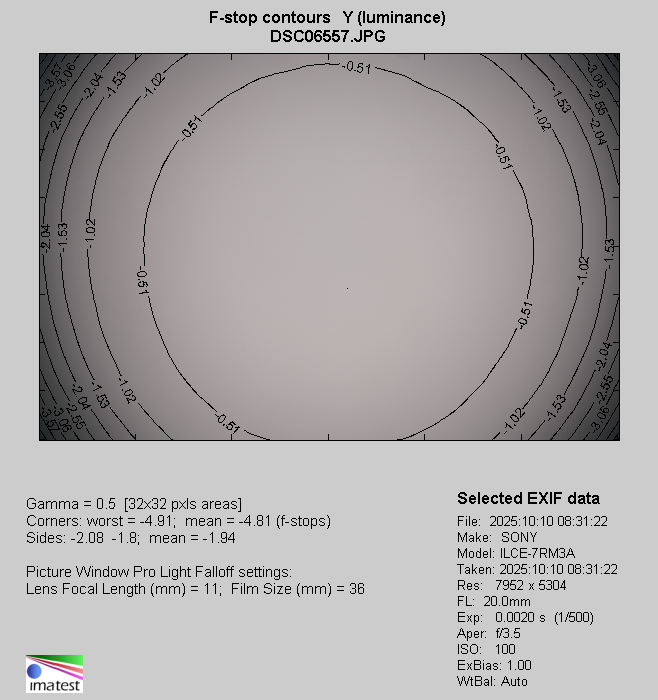
The final effect can be called dramatic. A combination of the 20 mm focal length and the maximum relative aperture provides brightness loss in frame corners of a truly monstrous level, that of 81% (-4.81 EV), a kind of notorious record in our tests.
Stopping down the aperture to f/4.0 decreases this aberration to 78% (-4.35 EV), by f/5.6 it reaches 67% (-3.17 EV). Results we got by f/8.0, f/11, and f/16 are, respectively: 56% (-2.39 EV), 51% (-2.04 EV) and 47% (-1.86 EV).
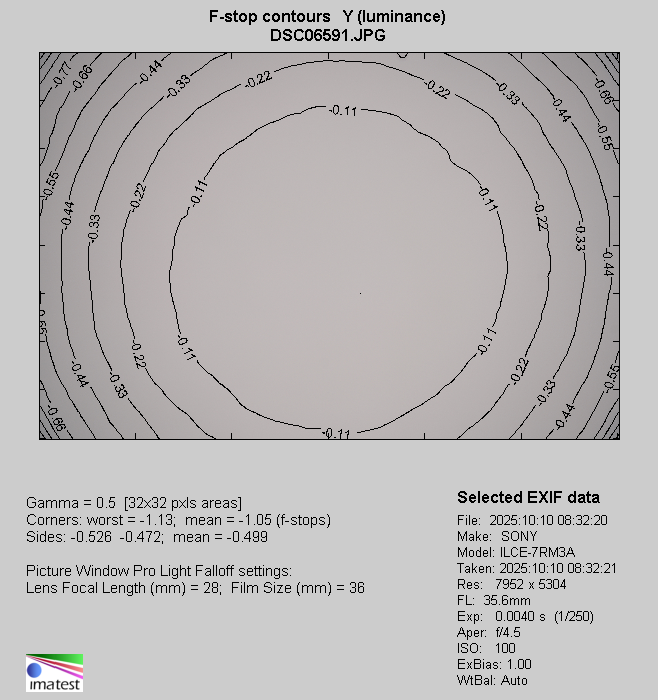
It is interesting that already at 35 mm there are far less problems. At the maximum relative aperture vignetting reaches 30% (-1.05 EV) and it decreases to 24% (-0.78 EV) on stopping down the aperture to f/5.6. From f/8.0 upwards you deal with the same level, reaching 18% (-0.57 EV).
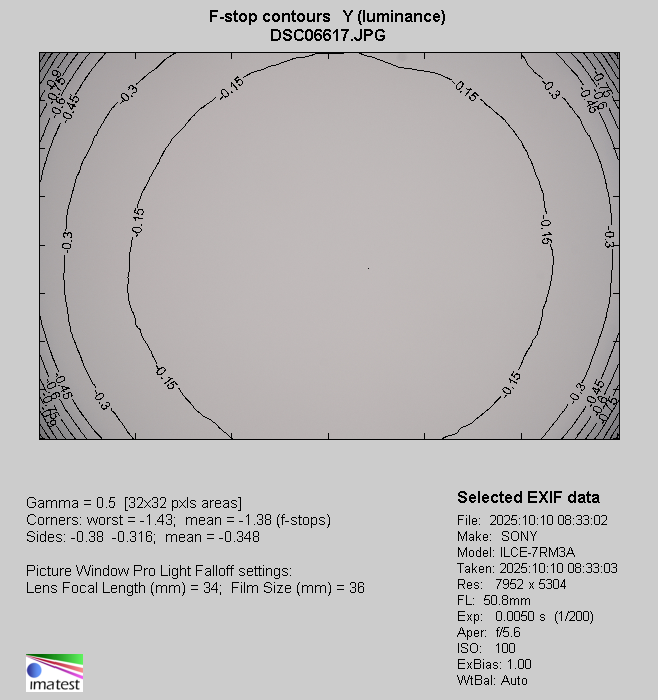
At 50 mm this aberration increases a bit because at the maximum relative aperture it is 38% (-1.38 EV) and it drops to 26% (-0.87 EV) on stopping down to f/8.0. By f/11 and f/16 apertures vignetting decreases respectively to 21% (-0.67 EV) and 15% (-0.46 EV).
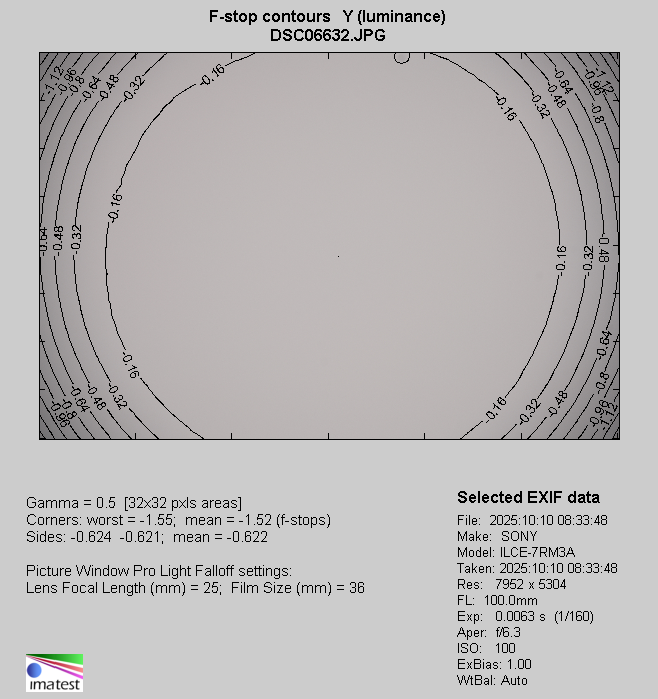
Another vignetting increase is visible at 100 mm, where by f/6.3 it reaches 41% (-1.52 EV), by f/8.0 it amounts to 33% (-1.17 EV), and by f/11 and f/16 it drops to 29% (-0.97 EV) and 23% (-0.78 EV).
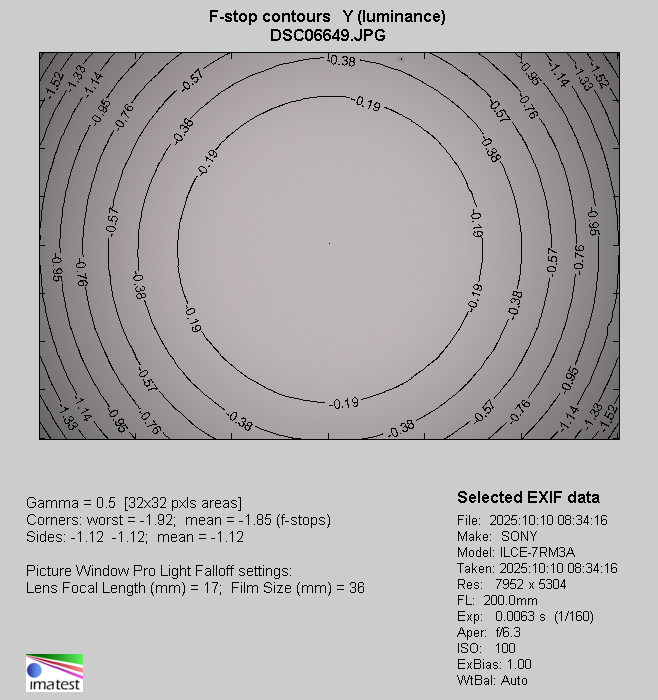
The maximum focal length means the return of serious problems but they are not as monstrous as at 20 mm. Here by f/6.3 brightness loss in frame corners amounts to 47% (-1.85 EV) and it decreases to 38% (-1.39 EV) by f/8.0. Employing f/11 reduces vignetting to 34% (-1.21 EV), and by f/16 it amounts to 30% (-1.04 EV).
| Sony A7R IIIa, 20 mm, JPEG, f/3.5 |
 |
| Sony A7R IIIa, 35 mm, JPEG, f/4.5 |
 |
| Sony A7R IIIa, 50 mm, JPEG, f/5.6 |
 |
| Sony A7R IIIa, 100 mm, JPEG, f/6.3 |
 |
| Sony A7R IIIa, 200 mm, JPEG, f/6.3 |
 |
In order to be honest we had to check the distortion corrected (but not vignetting corrected) JPEG files. In this situation you still deal with fields of view that are slightly bigger than in official declarations so the huge asset of this lens in a form of an ultra wide angle of view is not limited in any way.
A combination of 20 mm and f/3.5 provides a result of 74% (-3.85 EV), so still very high. Applying of f/4.0 decreases vignetting to 70% (-3.51 EV), by f/5.6 you get a level of 57% (-2.44 EV), and by f/8.0 you see a value of 47% (-1.84 EV).
When it comes to the maximum focal length cropping images after distortion correction is so slight that the results don't differ from the previous ones by more than 1-2 percentage points. In other words we get a level corresponding to measurement errors.
| A7R IIIa, FF, JPEG CORR., 20 mm, f/3.5 | A7R IIIa, FF, JPEG CORR., 20 mm, f/4.0 |

|

|
| A7R IIIa, FF, JPEG CORR., 200 mm, f/6.3 | A7R IIIa, FF, JPEG CORR., 200 mm, f/8.0 |

|

|