Voigtlander Apo Lanthar 28 mm f/2 Aspherical
6. Distortion and field of view
Field of view
A rectilinear 28 mm lens on a full frame sensor should provide you an angle of view of 75.4°, but the producers of the Voigtlander Apo Lanthar 2/28 in their official specifications, state a slightly lower value, that of 74°. Of course we decided to check how big this field really is. To do so, we took photos of a starry sky and saved them as uncorrected JPEG files. Then we transformed the pixel layout (X,Y) from the photo into the equatorial coordinate system (right ascension and declination), which locates a star on a celestial sphere. That way we were able to measure the field very precisely and exactly as it should be done for rays of light coming from infinity. Our transformation was based on positions of 221 stars spread evenly across the frame. An average mesh-fitting error amounted to 1 minute and 7 seconds of arc. The result we got amounts to 74.14° with a measurement error on a level of 0.03 of a degree, so it is almost perfectly in accordance with the value stated by the producers.Distortion
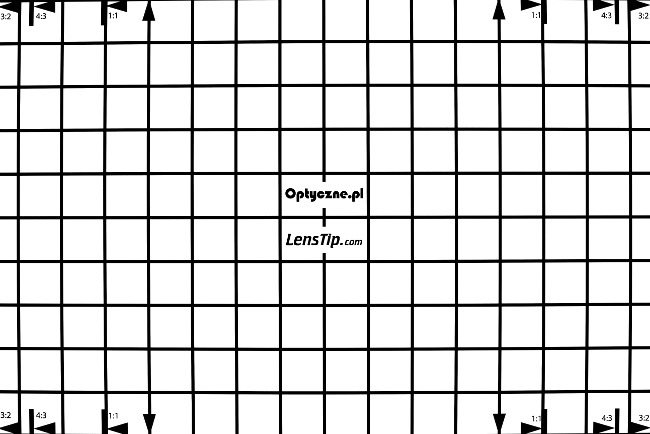
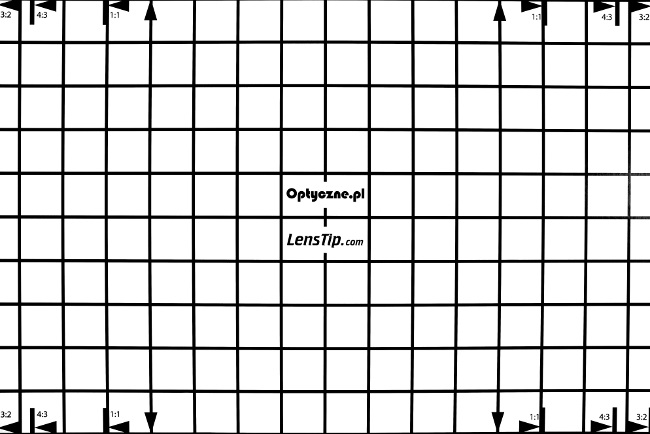
Lenses with an angle of view exceeding 70° can have plenty of problems with the correction of geometric deformations. Fortunately, the tested Voigtlander performs really well in this area.At the smaller APS-C sensor, you can notice a low level of barrel distortion and its value we determined as -0.87%. What's interesting, after passing to the full frame this result remains roughly the same, reaching -0.81%.
To explore distortion more thoroughly, we decided to check how its level changes as you move away from the photographed object. We found out that at the minimum focusing distance, its level is the lowest, reaching just -0.66%. The highest distortion level, that of -0.83%, we got at infinity.
Please Support UsIf you enjoy our reviews and articles, and you want us to continue our work please, support our website by donating through PayPal. The funds are going to be used for paying our editorial team, renting servers, and equipping our testing studio; only that way we will be able to continue providing you interesting content for free. |
- - - - - - - - - - - - - - - - - - - - - - - - - - - - - - - - - - - - - - - - - - - - - - - -
All results presented here are, in terms of absolute value, noticeably lower than 1%. It means that this aberration is kept firmly in check, and the tested Voigtlander deserves to be praised. With its small physical dimensions, this lens could have given up distortion correction and dumped this task on the software of a camera; fortunately, its designers didn't follow this path and they corrected deformations with optics. They deserve our respect, especially after reminding ourselves that distortion of the Sony 2/28 on full frame reached -4.82%.
| Sony A7R IIIa, 28 mm, APS-C | |||
 |
|||
| Sony A7R IIIa, 28 mm, FF | |||
 |
|||