Voigtlander Apo Lanthar 28 mm f/2 Aspherical
4. Image resolution
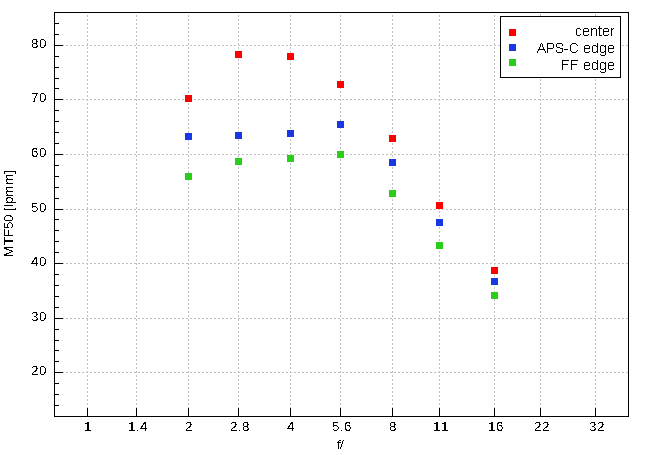
Let's check how the Voigtlander Apo Lanthar 28 mm f/2 Aspherical compares; its performance in the frame centre, on the edge of the APS-C/DX and on the edge of full frame is presented in a graph below.
Please Support UsIf you enjoy our reviews and articles, and you want us to continue our work please, support our website by donating through PayPal. The funds are going to be used for paying our editorial team, renting servers, and equipping our testing studio; only that way we will be able to continue providing you interesting content for free. |
- - - - - - - - - - - - - - - - - - - - - - - - - - - - - - - - - - - - - - - - - - - - - - - -
When it comes to the frame centre, the results are splendid indeed. Already at the maximum relative aperture, you deal with a very high level of over 70 mm; near f/2.8 and f/4.0 apertures, the resolution, measured by us, reached 78 lpmm. It is not a record-breaking level, but it would be foolish to think that a lens with such dimensions and aperture fastness might break any records.
It's worth reminding here that the rival Sony FE 28 mm f/2 at the maximum relative aperture didn't exceed 40 lpmm and its maximum resolution value amounted to almost 67 lpmm. In this aspect the Voigtlander fares a lot better. Small physical dimensions of the Apo Lanthar made us worried about its performance on the edge of the frame, but our fears were unfounded. The Voigtlander performs surprisingly well both on the edge of the APS-C/DX and on the edge of full frame. Perhaps it is not an entirely classic performance, because the MTFs either remain at the same level or increase very slowly with the initial stopping down of the aperture, but it is due to a very specific chromatic aberration performance and we are going to deal with it in the next chapter. Of course it doesn't change the fact that up from the maximum relative aperture, you get very high results that are beyond reproach.
Instead of comparing the Voigtlander to its rivals, we decided to compare its performance to that of other Apo Lanthar devices we've already tested.
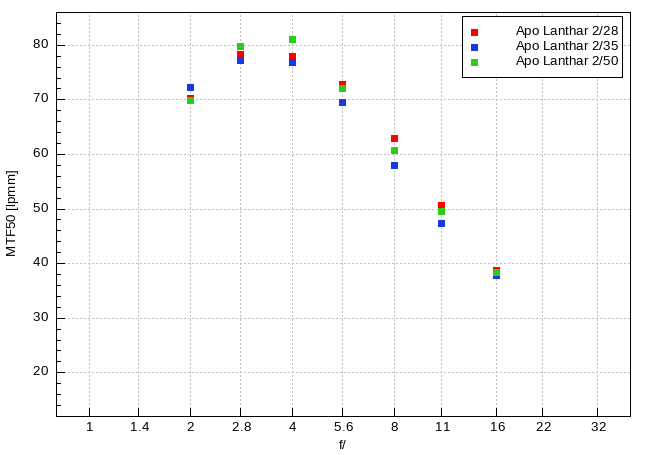
Now it's clear you deal with a very consistent line of products, and very well done in terms of performance. I do appreciate these lenses just because they can combine moderate weight and dimensions with good parameters without any significant resolution drop. The Voigtlander Apo Lanthar 28 mm f/2 Aspherical fits this idea to a dot and is every bit as good as its older brothers – a round of applause!
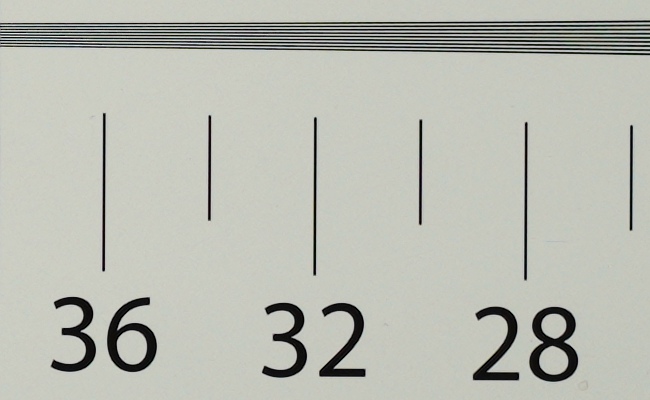
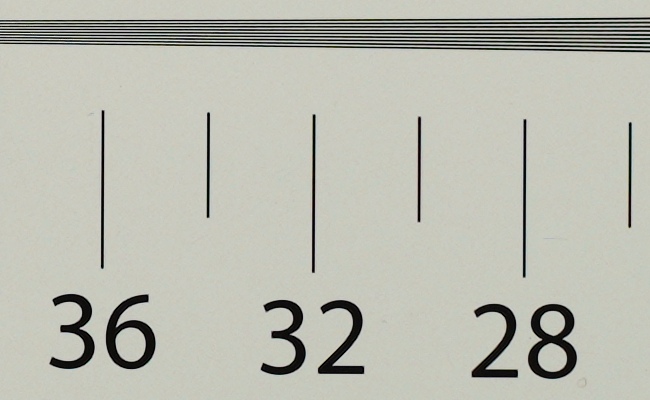
At the end of this chapter, traditionally, we present crops taken from photos of our resolution testing chart, saved as JPEG files along with RAW files we used for the analysis above.
| A7R IIIa, JPEG, 28 mm, f/2.0 |
 |
| A7R IIIa, JPEG, 28 mm, f/2.8 |
 |