Voigtlander Apo Lanthar 28 mm f/2 Aspherical
8. Vignetting
| A7R IIIa, APS-C, f/2.0 | A7R IIIa, APS-C, f/2.8 |

|

|
At the maximum relative aperture, vignetting can be noticed, reaching 32% (-1.10 EV). All problems end by f/2.8 and f/4.0, where we got, respectively, 15% (-0.47 EV) and 13% (-0.39 EV).
Please Support UsIf you enjoy our reviews and articles, and you want us to continue our work please, support our website by donating through PayPal. The funds are going to be used for paying our editorial team, renting servers, and equipping our testing studio; only that way we will be able to continue providing you interesting content for free. |
- - - - - - - - - - - - - - - - - - - - - - - - - - - - - - - - - - - - - - - - - - - - - - - -
After passing to the bigger, full frame sensor, there are far more problems and photos below emphasize it very well.
| A7R IIIa, FF, f/2.0 | A7R IIIa, FF, f/2.8 |

|

|
| A7R IIIa, FF, f/4.0 | A7R IIIa, FF, f/5.6 |

|

|
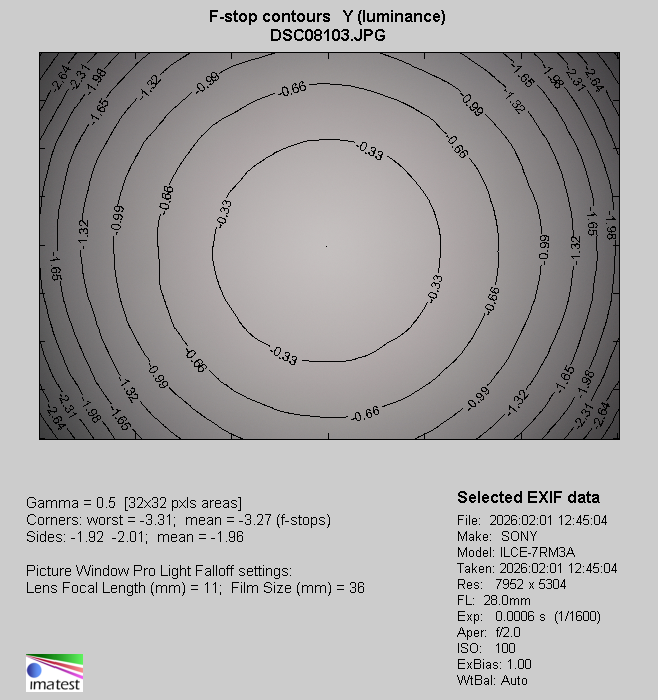
At the maximum relative aperture, we got a huge result, amounting to 68% (-3.27 EV). By f/2.8 this aberration still reaches a very high level of 52% (-2.11 EV); by f/4.0 it decreases to 37% (-1.34 EV); by f/5.6 it is 35% (-1.23 EV), and by f/8.0 it drops to 33% (-1.18 EV). Further stopping down doesn't provide any measureable effects.
Vignetting is one of the few categories where the Apo Lanthar officially performs weaker than the Sony FE 28 mm f/2 as in its case vignetting by f/2.0 amounted to 67%. Still, 1 percentage point of difference is within our limits of measurement error, so to be honest, you should say that in this category both lenses fare similarly.
| Sony A7R IIIa, JPEG, f/2.0 |
 |