Viltrox AF 35 mm f/1.8 EVO
4. Image resolution
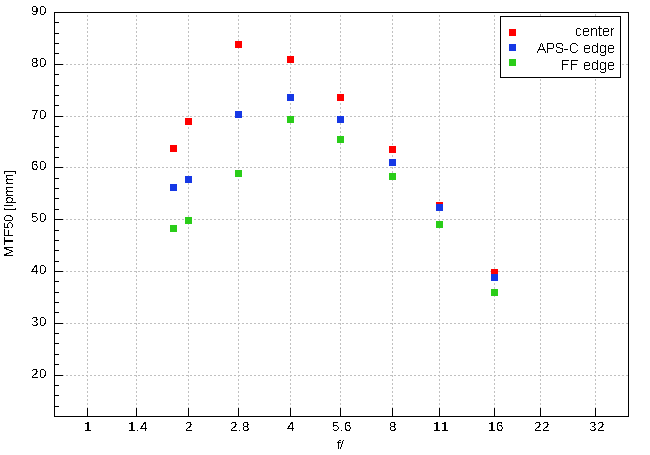
Let's check how the Viltrox AF 35 mm f/1.8 EVO fares in the frame centre, on the edge of the APS-C/DX, and on the edge of full frame.
Please Support UsIf you enjoy our reviews and articles, and you want us to continue our work please, support our website by donating through PayPal. The funds are going to be used for paying our editorial team, renting servers, and equipping our testing studio; only that way we will be able to continue providing you interesting content for free. |
- - - - - - - - - - - - - - - - - - - - - - - - - - - - - - - - - - - - - - - - - - - - - - - -
The results in the frame centre are really excellent. Already at the maximum relative aperture, you deal with a good value, reaching almost 64 lpmm. As if it wasn't enough, the optics of the Viltrox react very well on stopping down the aperture, so, by f/2.8, you see an impressive 83.8 lpmm.
The performance on the edge of the APS-C/DX sensor can also be described in superlatives only. At the maximum relative aperture, you get a really good result of near 56 lpmm and on stopping down, the lens approaches an impressive level of over 70 lpmm.
The edge of full frame is not much weaker. Even at the maximum relative aperture, image quality is completely sufficient, and near f/4.0 the results brush against a high level of 70 lpmm. As a result, at this relative aperture exactly, you have an opportunity to take photos whose sharpness will satisfy even very demanding users across the frame.
At the end we are going to compare the tested lens to its direct rivals, the Sony AF 35 mm f/1.8 and the Nikkor Z 35 mm f/1.8 S. Both models have been present on the market for 6-7 years and this simple truth is reflected in their performance.
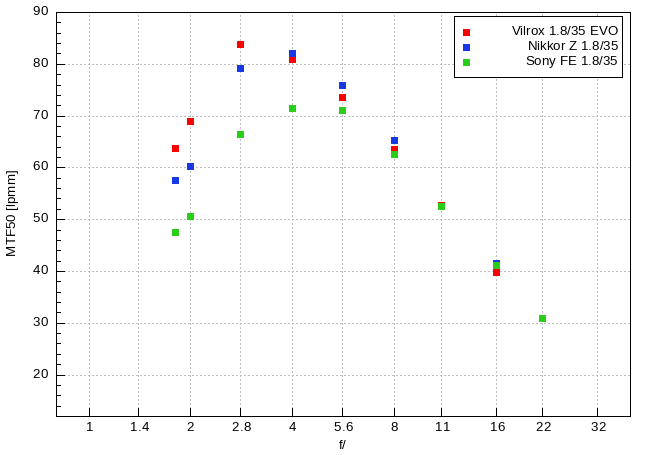
The much newer and optically more complex Viltrox shows that currently you can offer a lens with a noticeably better performance and it might cost several hundred PLN less at the same time.
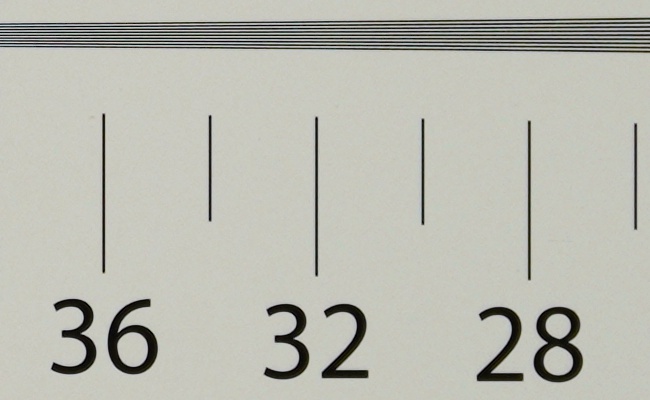
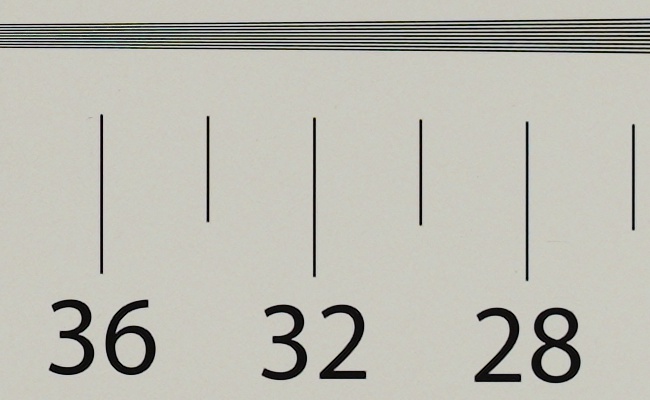
At the end of this chapter, traditionally, we present crops taken from photos of our resolution, which were saved as JPEGs along with RAWs we used for the analysis above.
| A7R IIIa, JPEG, 35 mm, f/1.2 |
 |
| A7R IIIa, JPEG, 35 mm, f/2.8 |
 |