Viltrox AF 35 mm f/1.8 EVO
8. Vignetting
| A7R IIIa, APS-C, f/1.8 | A7R IIIa, APS-C, f/2.0 |

|

|
Even at the maximum relative aperture, vignetting is not especially bothersome, reaching a moderate value of 28% (-0.96 EV). The aperture change into f/2.0 makes this aberration decrease to a level of 24% (-0.78 EV), and by f/2.8 any vignetting problems end completely, with a result of just 10% (-0.32 EV).
Please Support UsIf you enjoy our reviews and articles, and you want us to continue our work please, support our website by donating through PayPal. The funds are going to be used for paying our editorial team, renting servers, and equipping our testing studio; only that way we will be able to continue providing you interesting content for free. |
- - - - - - - - - - - - - - - - - - - - - - - - - - - - - - - - - - - - - - - - - - - - - - - -
After passing to a bigger, full frame sensor, there are noticeably more issues, and the photos below present it quite clearly.
| A7R IIIa, FF, f/1.8 | A7R IIIa, FF, f/2.0 |

|

|
| A7R IIIa, FF, f/2.8 | A7R IIIa, FF, f/4.0 |

|

|
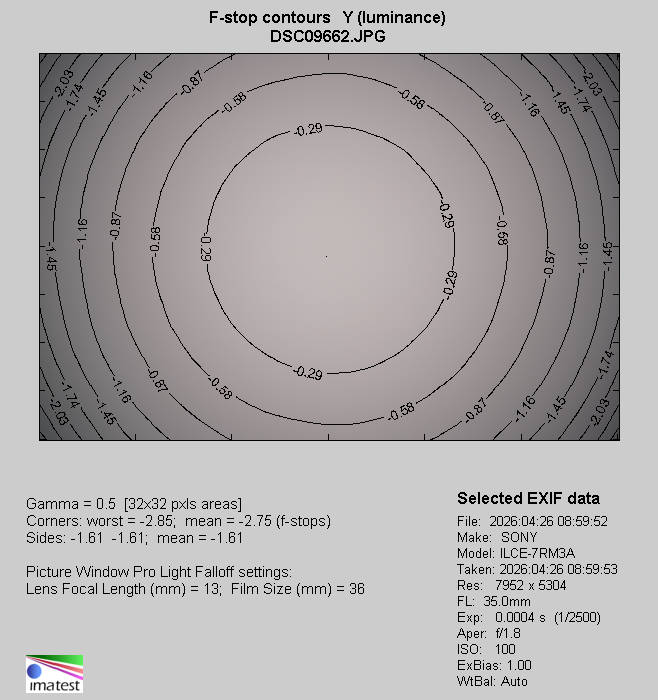
At the maximum relative aperture, we got a very high result, reaching 61% (−2.75 EV). What about the rivals? The Nikkor fares a tad better (57%), and the Sony even weaker (67%).
By f/2.0 this aberration reaches 58% (-2.53 EV), by f/2.8 it decreases to 41% (-1.52 EV), and by f/4.0 it amounts to 33% (-1.28 EV). You can still notice vignetting by f/5.6 and f/8.0, where we get, respectively, 30% (-1.01 EV) and 29% (-0.98 EV). Further stopping down of the aperture doesn't provide any measureable effects.
| Sony A7R IIIa, JPEG, f/1.8 |
 |