Sigma A 35 mm f/1.4 DG II
4. Image resolution
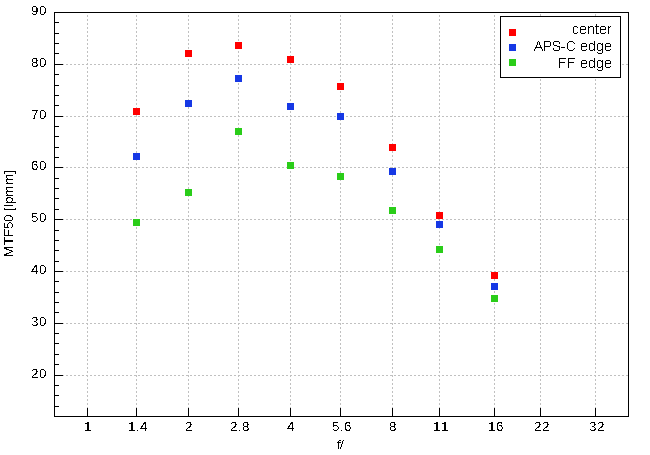
Let's check how the Sigma A 35 mm f/1.4 DG II performs in the frame centre, on the edge of the APS-C/DX sensor and on the edge of full frame.
Please Support UsIf you enjoy our reviews and articles, and you want us to continue our work please, support our website by donating through PayPal. The funds are going to be used for paying our editorial team, renting servers, and equipping our testing studio; only that way we will be able to continue providing you interesting content for free. |
- - - - - - - - - - - - - - - - - - - - - - - - - - - - - - - - - - - - - - - - - - - - - - - -
The results in the frame centre are simply sensational. Already at the maximum relative aperture the resolution exceeds an impressing level of almost 71 lpmm. By f/2.0 it increases to 82.2 lpmm and the peak of the performance the lens reaches by f/2.8, with a result of 83.6 lpmm.
Of course these results should be compared to the results of the direct rivals – let's glance at a graph below.
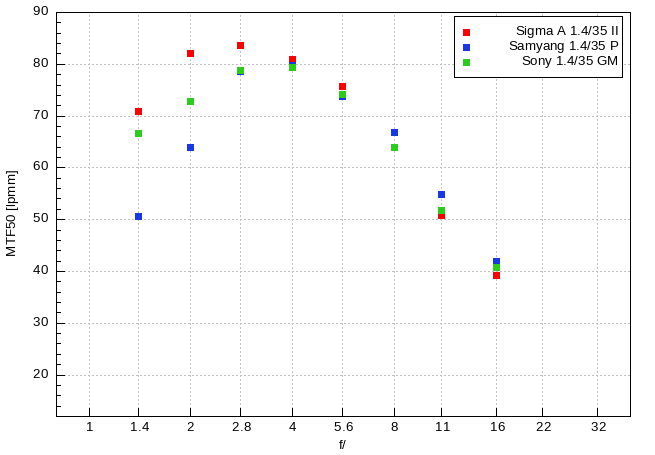
You could expect that the new Sigma fared better than the cheaper Samyang but the result of a duel between the tested lens and the more expensive Sony G-Master model was a puzzle. As you see both lenses have practically identical results up from f/4.0 but in the wide areas near the maximum relative aperture the Sigma prevails – a round of applause!
Now let's return to the first graph from this chapter and assess the performance on the edge of the APS-C sensor. It is similarly brilliant. The results start from 62.3 lpmm by f/1.4, increase quite quickly, and by f/2.8 we see a really impressing value of 77.2 lpmm. Many fixed focal length lenses we've had an opportunity to test had problems to achieve such a result in the frame centre. As you see the Sigma deserves to be only praised in this area.
When it comes to the edge of full frame the situation is similar – at the maximum relative aperture the results reach almost 50 lpmm, distinctly above the decency level. On stopping down the aperture you are able to reach 67 lpmm – it means that in the aperture range from f/2.8 to f/5.6 you can get very sharp images across the full frame.
As a summary you can say that the slimming treatment the second version of the Sigma A 1.4/35 had undergone didn't affect adversely its resolution. The new lens performs in this category really well.
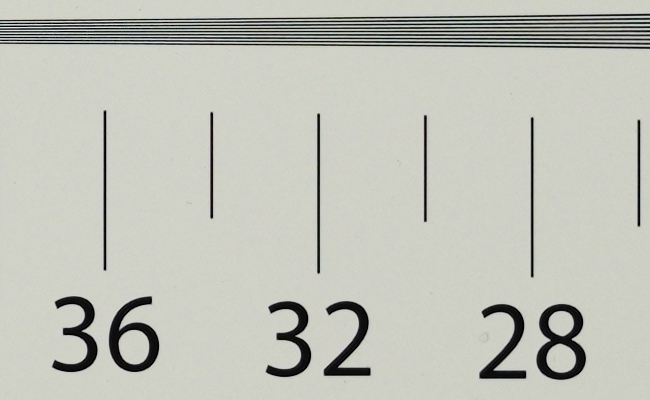
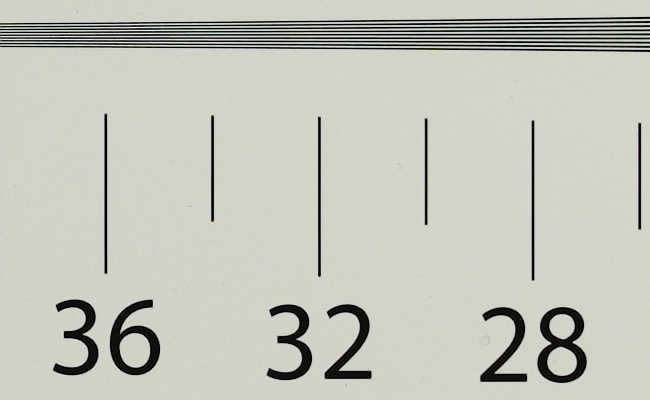
At the end of this chapter, traditionally, we present crops taken from photos of our resoluchart chart, which were saved as JPEGs along with RAWs we used for the analysis above.
| A7R IIIa, JPEG, 35 mm, f/1.4 |
 |
| A7R IIIa, JPEG, 35 mm, f/2.8 |
 |