The following chart presents a comparison between basic parameters of the Sirui Aurora 35 mm f/1.4 and other 1.4/35 class models designed for full frame mirrorless devices. As you can notice, the Aurora is here a lens optically most complex, with the highest number of elements inside. When it comes to optical groups it is defeated only by the new Sigma. The Sirui also features the highest number of aperture blades but when it comes to the minimum focusing distance its result is actually the weakest.
The weight of the Sirui is quite typical, fitting the middle of the range. The tested lens is also the longest in this group, with significant width – only the Canon is wider.
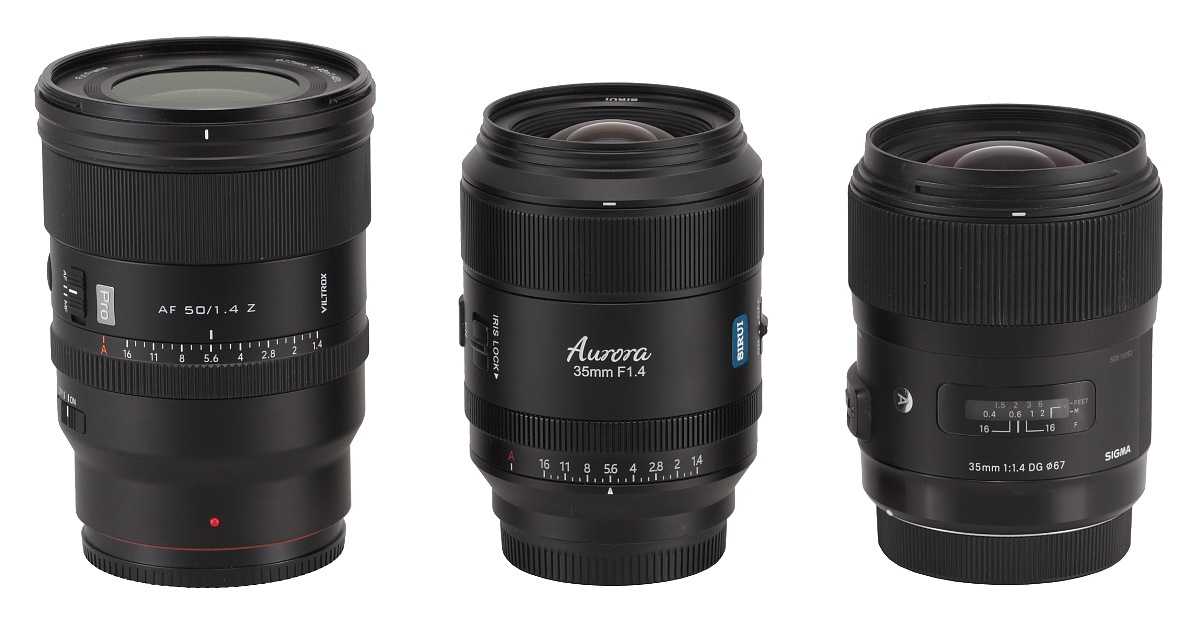
In the photo below the Sirui Aurora 1.4/35 is positioned between the Viltrox AF 50 mm f/1.4 Pro and the reflex camera Sigma A 35 mm f/1.4 DG HSM.
Please Support Us
If you enjoy our reviews and articles, and you want us to continue our work please, support our website by donating through PayPal. The funds are going to be used for paying our editorial team, renting servers, and equipping our testing studio; only that way we will be able to continue providing you interesting content for free.
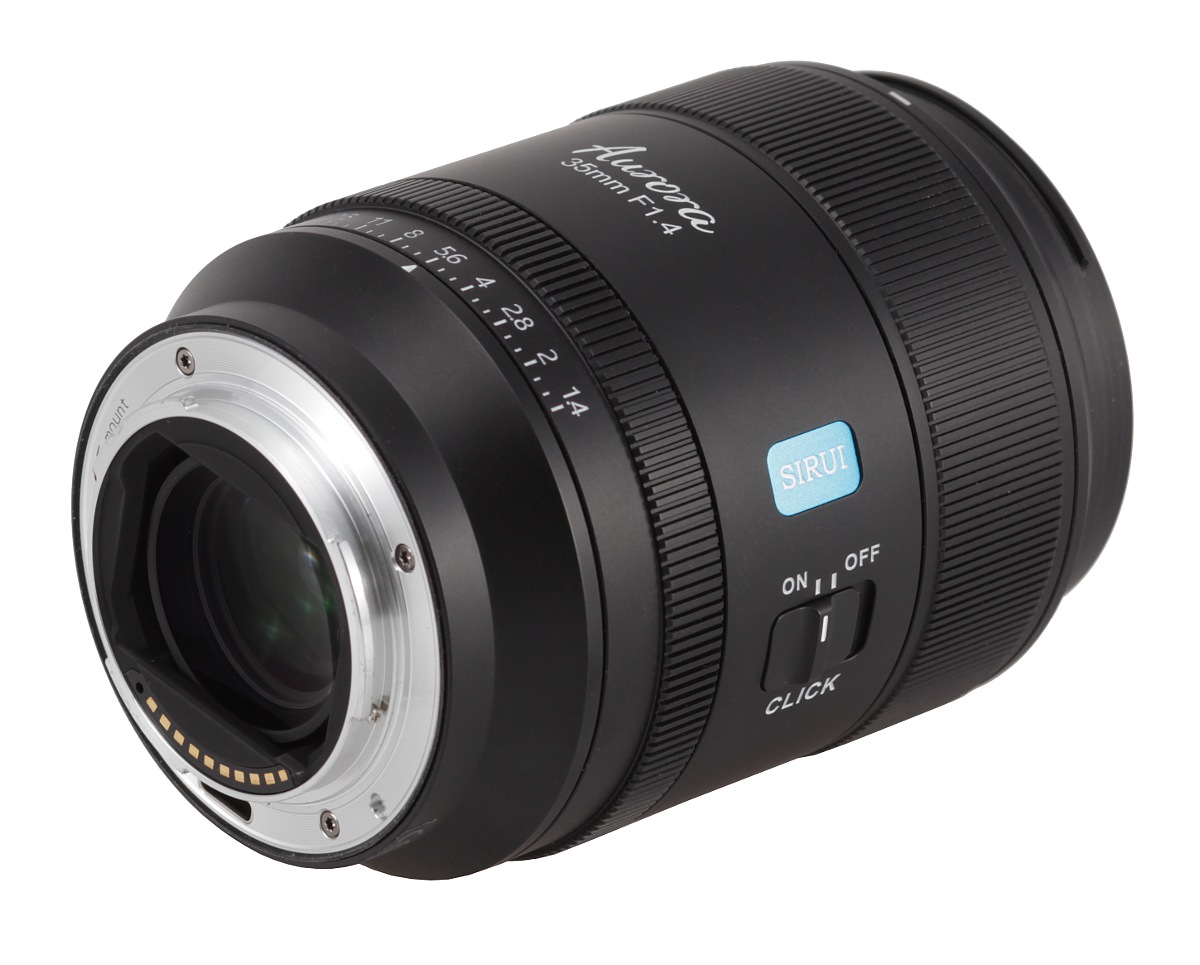
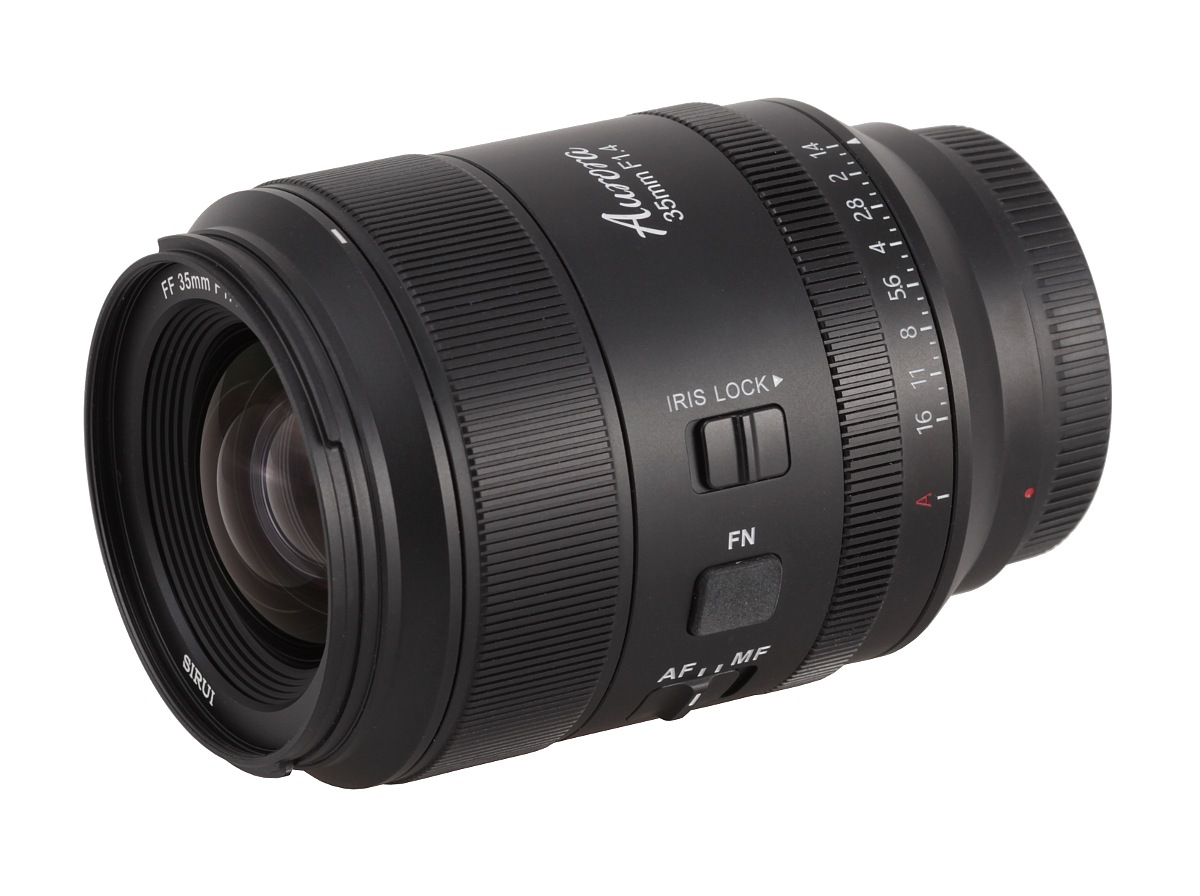
The tested lens starts with a metal mount with a USB-C port through which you can download software upgrades and program different buttons. There's also mount version (E-mount in this case) given. The mount surrounds contacts and a black 33x27 mm frame made of plastics. Under the frame there is a bushing inside which you can find a rear element that doesn't move, 29 mm in diameter. All of this is properly blackened and matted.
The proper body of the lens starts with a metal ring that increases its diameter. On this ring you find a red dot, making an alignment with a camera easier, and its serial number.
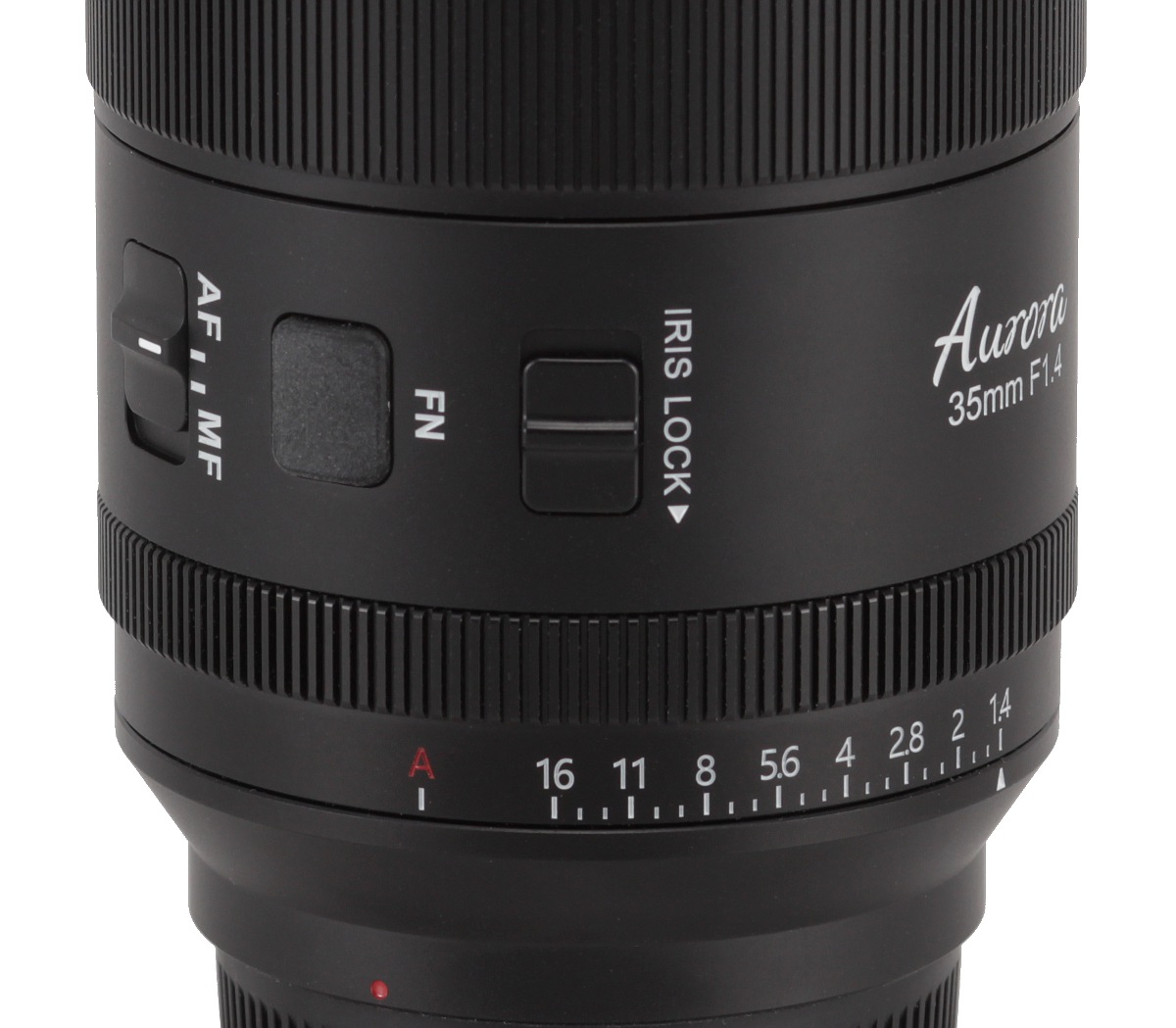
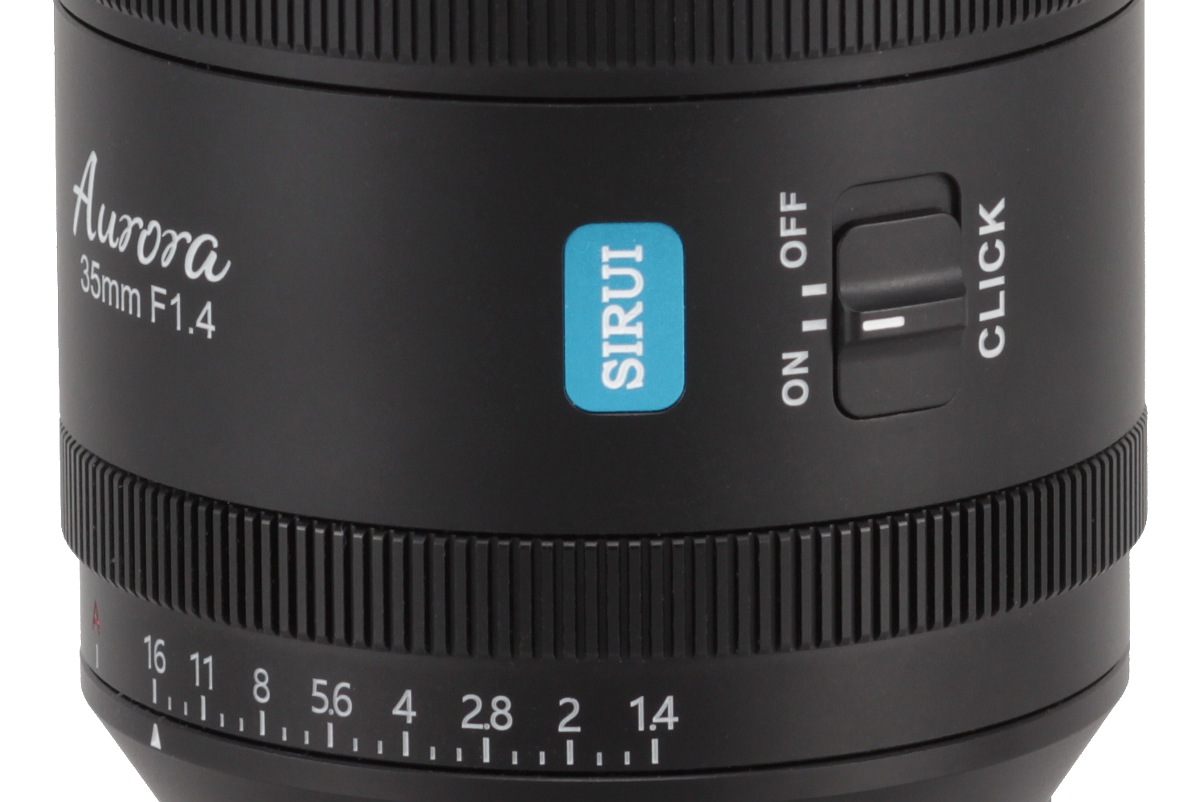
An aperture ring, as wide as 17 mm, is the next part. Its upper surface is covered by metal ribs and below you see aperture markings from f/1.4 to f/16 every 1/3 EV step and an automatic A value. The ring moves well and is properly damped; you can also declick it or leave it clicked.
Then you see an immobile part of the lens, 30 mm wide, where you can find an inscription with the name and parameters of the lens, a turquoise plate with the logo of the producer, and a whole array of toggles and switches. Looking from above, on the right you get a CLICK ON/OFF toggle, used to choose the aperture ring working mode. On the lleft,you see an IRIS LOCK toggle that allows you to block the aperture ring in a given position either in the manual range or in the A mode, followed by a function FN button and an AF/MF toggle that controls the focusing mechanism working modes.
Further on,you see a manual focus ring, as wide as 23 mm, almost completely covered by rubberized ribbing but without any depth of field or distance scale. It is a focus-by-wire construction; its resistance is rather slight but still acceptable. Its full focus throw needs an angle of 360-380 degrees and these values allow you very precise settings.
A metal ring decreasing its diameter and ending with a hood mount is the last part of the Sirui 1.4/35.
The front element of the lens is convex, 42 mm in diameter, situated inside a black, ribbed, small tube. It is additionally surrounded by a part of the casing with the parameters of the lens and a non-rotating filter thread, 62 mm in diameter.
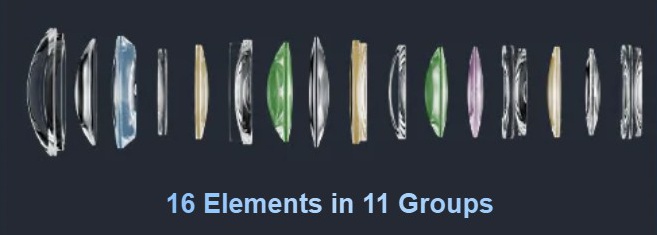
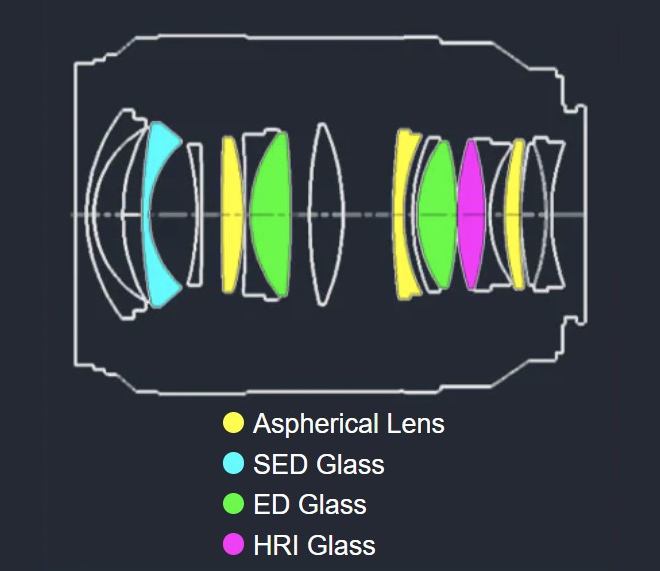
When it comes to optical construction, you deal here with 16 elements positioned in 11 groups and the number of special elements is really impressive. In the front part of this system, the producers used one SED element (Super Extra-low Dispersion glass element) and further on you can find two ED elements. Apart from that there are three aspherical elements and one made of glass with high refraction index (HRI). Inside there is also a round aperture with 13 blades that, in theory, can be closed down to a value of f/16 (in the next chapter we are going to check that in practice).
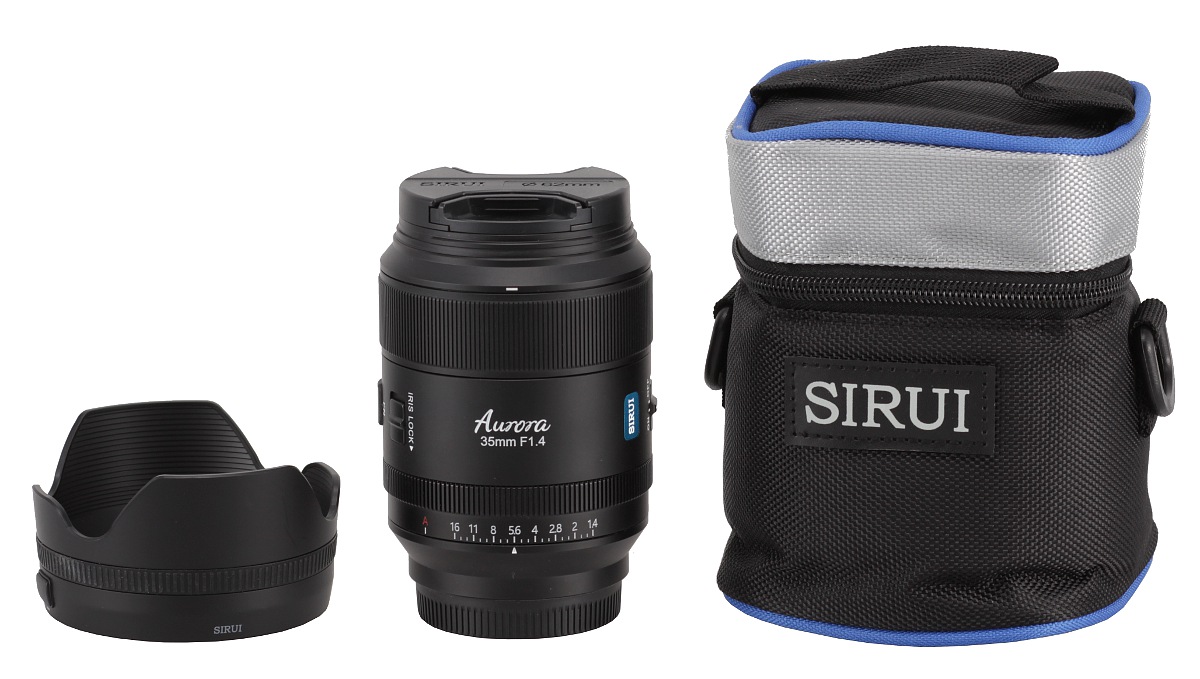
This very sensibly priced instrument also impresses with its standard accessory kit. In the box with the lens, you find both caps, a petal-type hood, and a quite solid case, a rarity nowadays. Most producers don't offer you good quality cases with their lenses – they either don't add anything at all, or they include a fabric bag with doubtful protective properties.
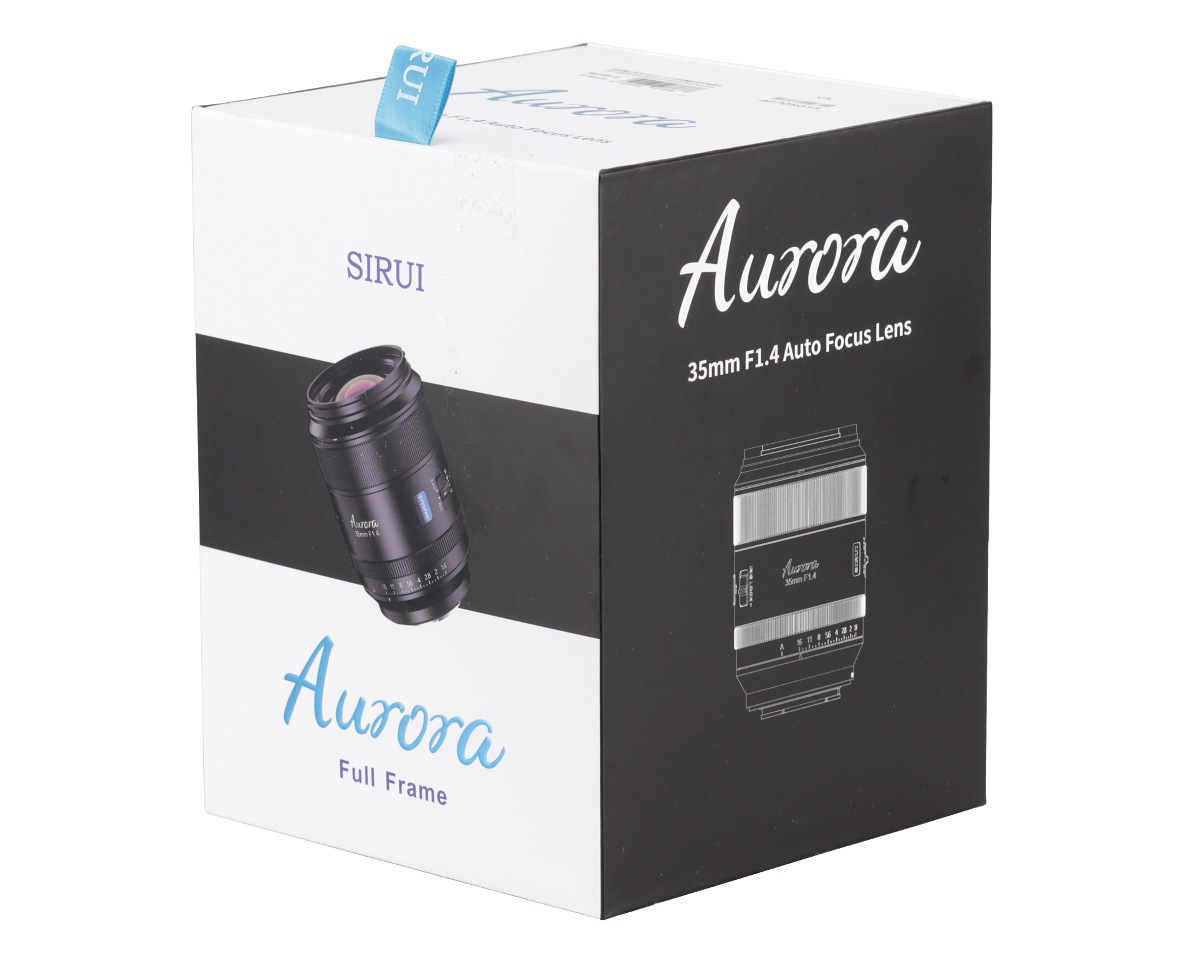
As we start tests of lenses from a new producer, we also would like to show you the photo of the cardboard box the lens is put into – you can find it below.