Sirui Aurora 35 mm f/1.4
5. Image resolution
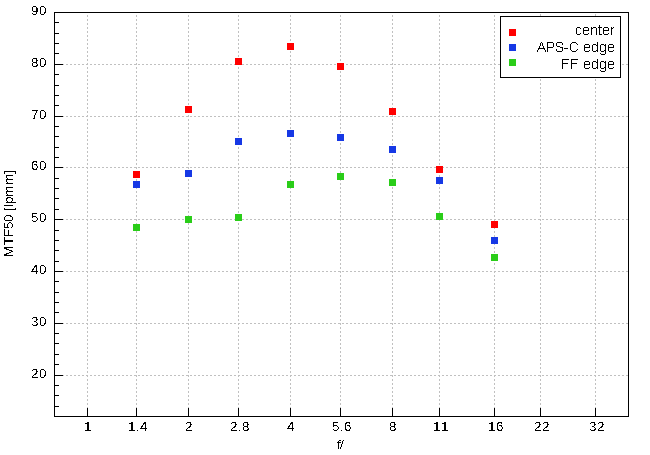
Let's check how the Sirui Aurora 35 mm f/1.4 performs in the frame centre, on the edge of the APS-C/DX sensor and on the edge of full frame.
Please Support UsIf you enjoy our reviews and articles, and you want us to continue our work please, support our website by donating through PayPal. The funds are going to be used for paying our editorial team, renting servers, and equipping our testing studio; only that way we will be able to continue providing you interesting content for free. |
- - - - - - - - - - - - - - - - - - - - - - - - - - - - - - - - - - - - - - - - - - - - - - - -
The centre of the frame looks really well. At the maximum relative aperture, you see a very high result, approaching 60 lpmm. On stopping down you can see even 80 lpmm. Officially the peak of performance we reached by f/4.0 and it amounted to 83.4 lpmm with a measuring error on a level of 1.3 lpmm.
If you want to compare these values to the direct rivals, you have to do something more – show on a graph the real aperture values we determined in the previous chapter.
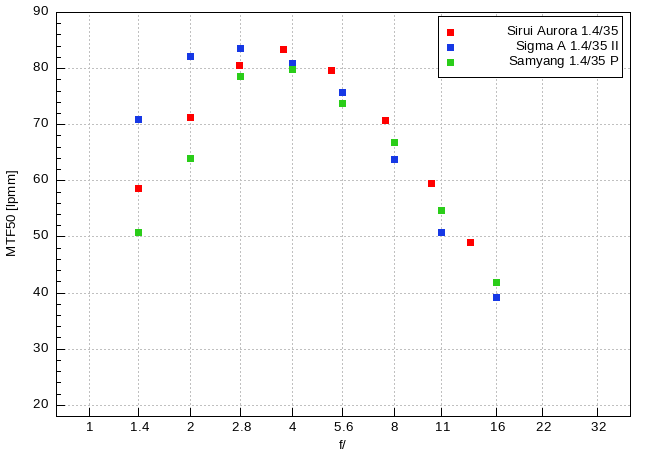
It's clear that near the maximum relative aperture the Sirui is defeated by the Sigma but its maximum results are practically the same as the results of the more expensive competitor. At the same time, both the Sirui and the Sigma are noticeably better than the Samyang.
It's worth adding that the performance of the Sirui, here corrected to actual aperture values, are nonetheless a tad higher than the performance of its rivals. It might suggest that an assumption we adopted in the previous chapter, that by f/2.0 the Sirui's aperture value reflects the reality well, is still too optimistic. I suppose the real value at that place is closer to f/1.9.
Now let's return to the first graph of this chapter and describe the performance of the Aurora on the edge of the frame. In case of the APS-C/DX detector the situation still looks very good. MTFs at the maximum relative aperture don't differ much from the values observed in the frame centre. At the same time on stopping down we can get to close areas of an excellent level of 70 lpmm.
The edge of full frame lags noticeably, mainly because of a slow increase of resolution levels on stopping down. It is especially visible in areas close to the maximum relative aperture. Still, even there you see results nearing 50 lpmm – they are able to offer you fully useful images that are beyond reproach.
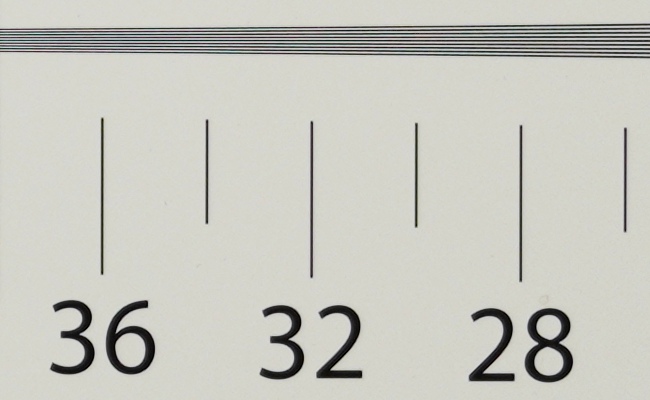
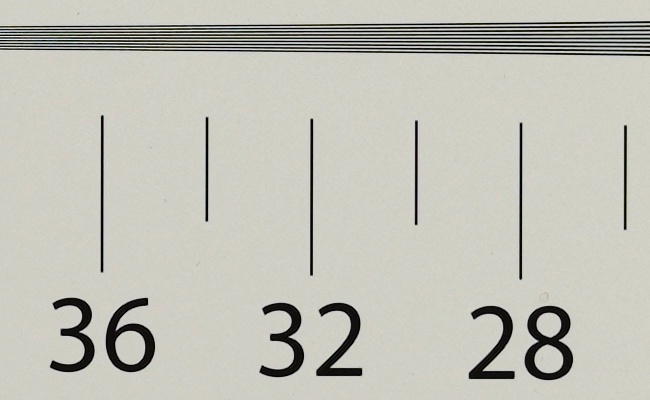
To sum up, when it comes to resolution, the Sirui Aurora 1.4/35 doesn't have any weaknesses and definitely should be praised here. At the end of this chapter, traditionally, we present crops taken from photos of our resolution testing chart that are taken from JPEG files saved alongside RAW files we used for the analysis above.
| A7R IIIa, JPEG, 35 mm, f/1.4 |
 |
| A7R IIIa, JPEG, 35 mm, f/4.0 |
 |