Sirui Aurora 85 mm f/1.4
4. Real relative aperture
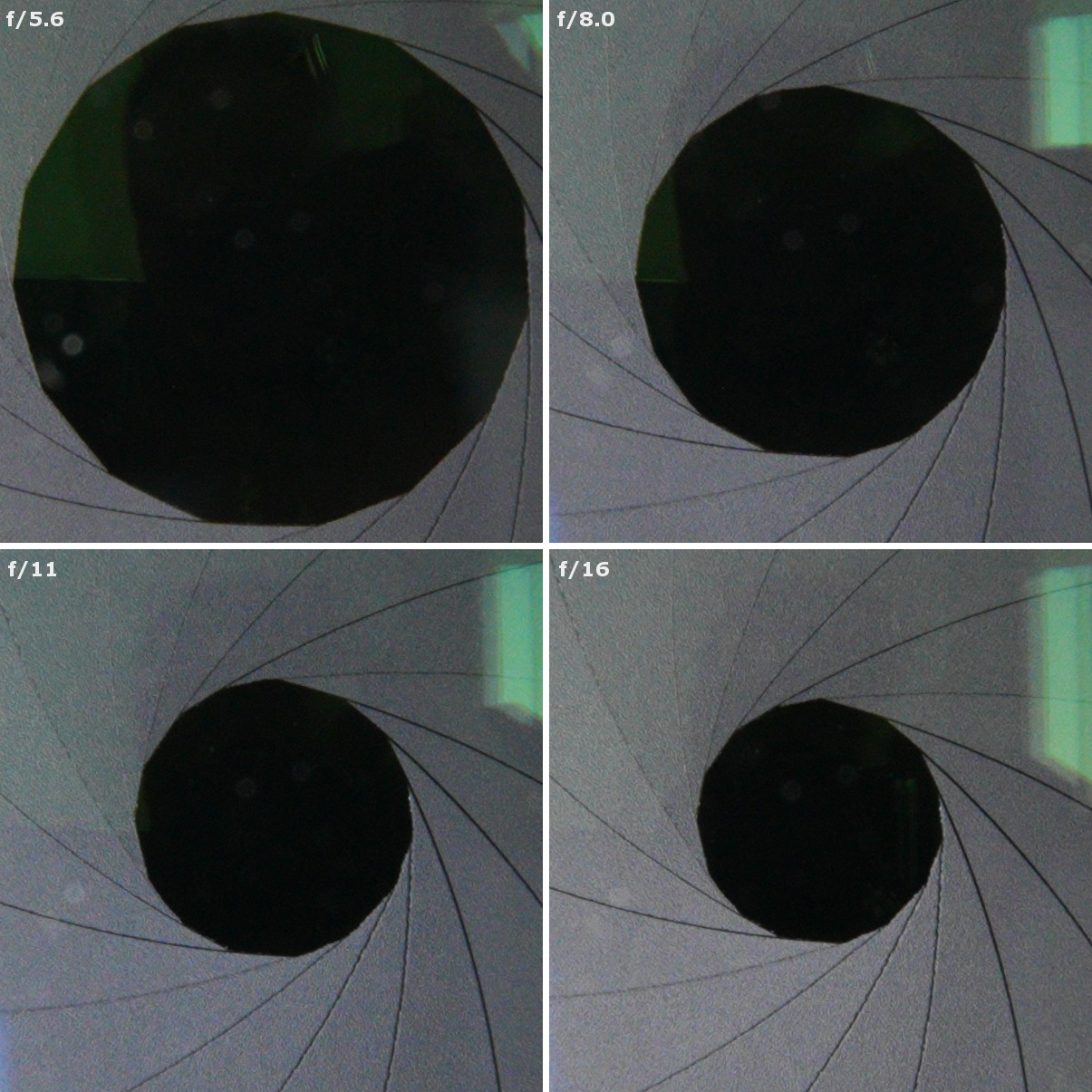
The photographs below show that the situation is indeed better because, unlike the 1.4/35 model, the aperture here is circular and does not show any noticeable asymmetry.
 |
Please Support UsIf you enjoy our reviews and articles, and you want us to continue our work please, support our website by donating through PayPal. The funds are going to be used for paying our editorial team, renting servers, and equipping our testing studio; only that way we will be able to continue providing you interesting content for free. |
- - - - - - - - - - - - - - - - - - - - - - - - - - - - - - - - - - - - - - - - - - - - - - - -
This confirms what we observed in the resolution measurements. Between the declared apertures of f/11 and f/16, instead of a 1.414× step, there is only a 1.135× change. As a result, the smallest available relative aperture of the Aurora 1.4/85 is not f/16, but a value closer to f/12.
Once again, this raises the question of why one would boast about an aperture with a record-breaking 15 blades, only to stumble when it comes to stopping it down...
In the case of a lens with a longer focal length, it is somewhat easier to photograph and determine the size of its entrance pupil. Once again, assuming that the f/2.0 relative aperture is correct, we can attempt to determine the actual light-gathering capability of the tested model. It appears to be worse than the declared f/1.4 value (or, more precisely, f/1.414), as our measurement yielded f/1.520. Even taking measurement errors and our assumptions into account, it therefore seems that the actual maximum aperture of the SIRUI Aurora 1.4/85 is closer to f/1.5 than f/1.4.
Our observation may be supported by the size of the front element. Although, as we noted in the previous chapter, it is not identical to the entrance pupil, the front element has a diameter of 58 mm. Meanwhile, dividing 85 mm by f/1.4 gives a theoretical entrance pupil diameter of 60.7 mm, which is noticeably larger than the front element.