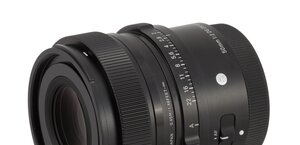
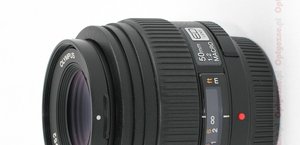
The following chart presents a comparison of basic parameters of different 24-70 mm f/2.8 class lenses designed to cooperate with full frame mirrorless cameras. The new Nikkor, compared to its predecessor, shortened its minimum focusing distance and increased the number of aperture blades,s but it was kind of necessary – it simply had to catch up with its rivals.
Simplifying the optical construction allowed us to decrease the weight so the new Nikkor is currently the lightest model in this group. It's also worth repeating that the current Nikkor version doesn't change its dimensions with the change of focal length, a significant asset, especially if you compare the tested lens to its predecessor and the majority of its rivals.
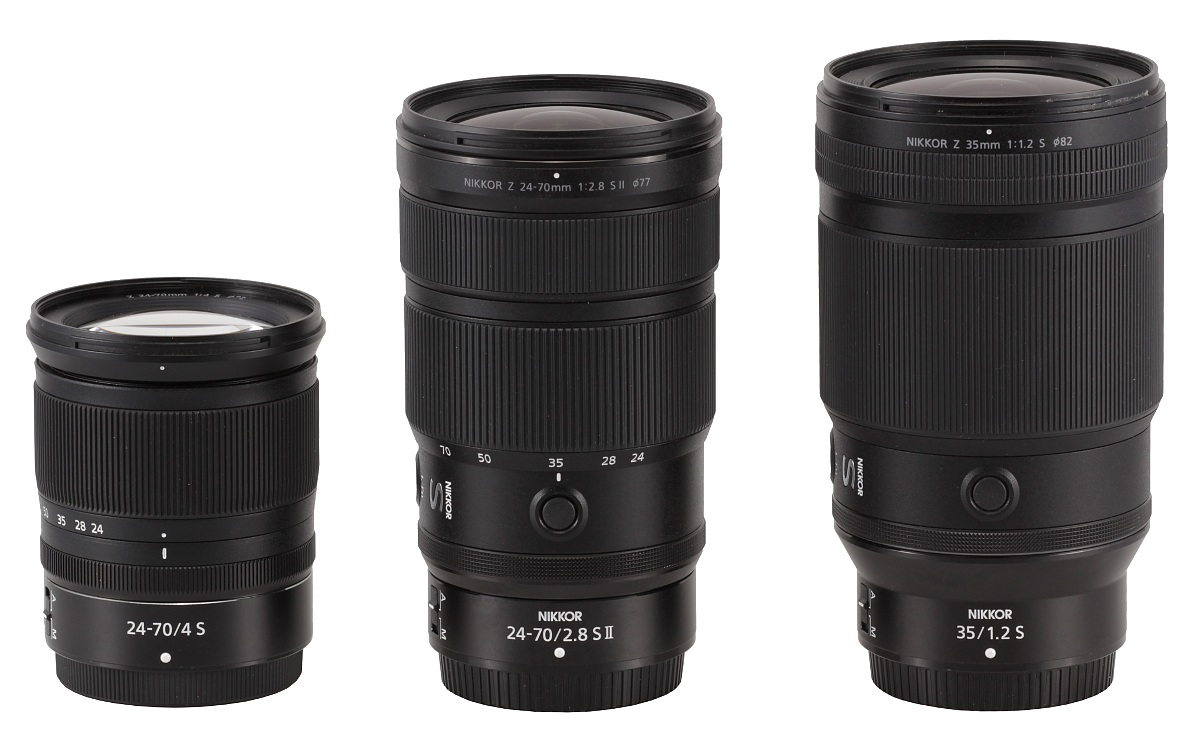
In the photo below the Nikkor Z 24-70 mm f/2.8 S II is positioned next to its system cousin with the same focal range but f/4 aperture, and the huge Nikkor Z 35 mm f/1.2 S.
Please Support Us
If you enjoy our reviews and articles, and you want us to continue our work please, support our website by donating through PayPal. The funds are going to be used for paying our editorial team, renting servers, and equipping our testing studio; only that way we will be able to continue providing you interesting content for free.
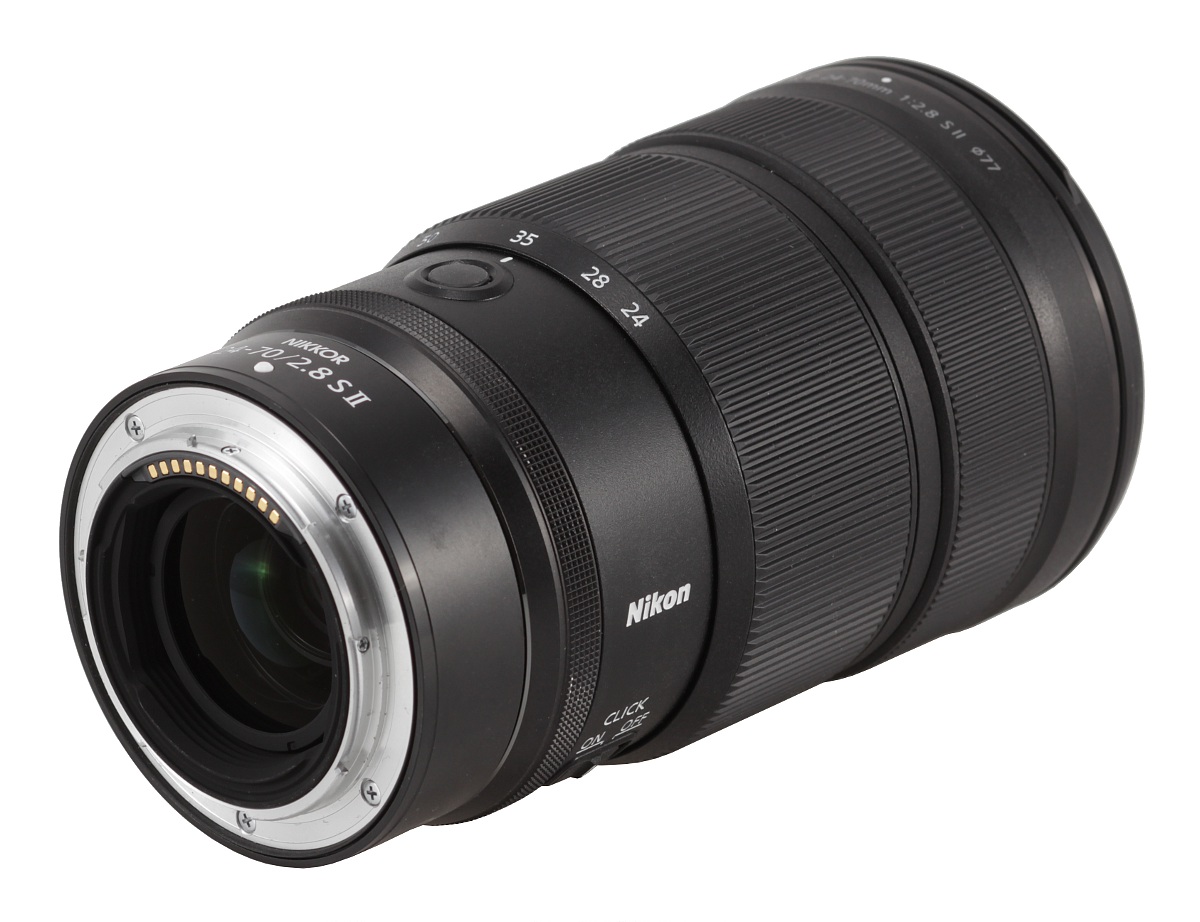
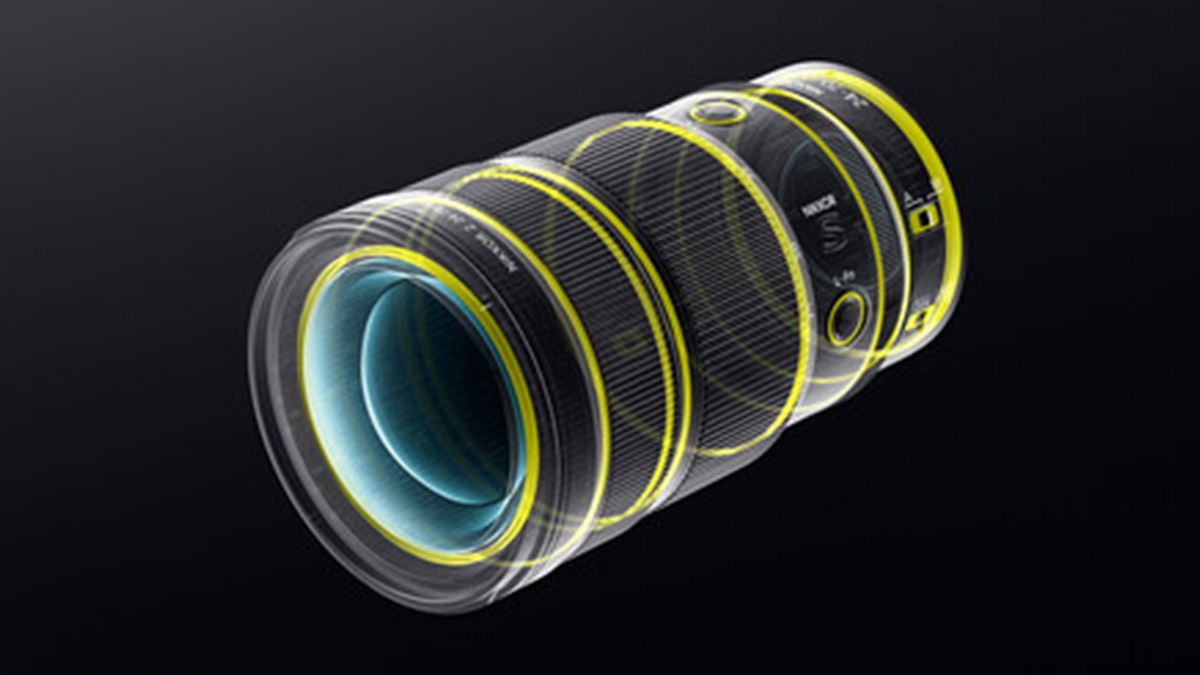
The tested lens starts with a metal mount surrounding contacts and a rear element 33 mm in diameter. At 24 mm this element is situated practically on the same level as the contacts and when you pass to 70 mm, it hides about 2 cm deep inside the barrel. The interior of the tube is properly blackened and baffled, but, unfortunately, we noticed some slits through which you can try to take a look inside; we couldn't spot any electronic parts but still. That's why we think you can't speak about a fully sealed barrel in this case.
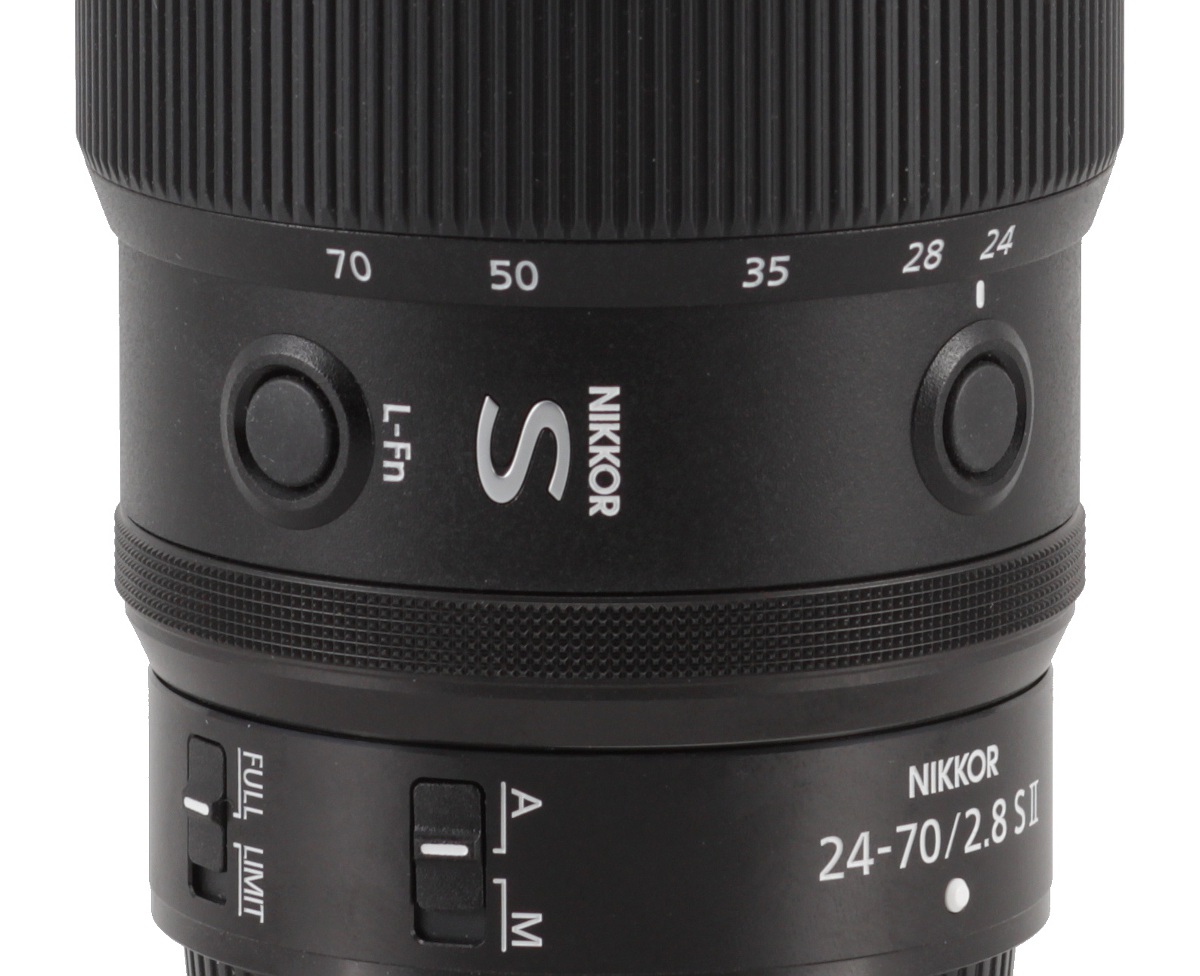
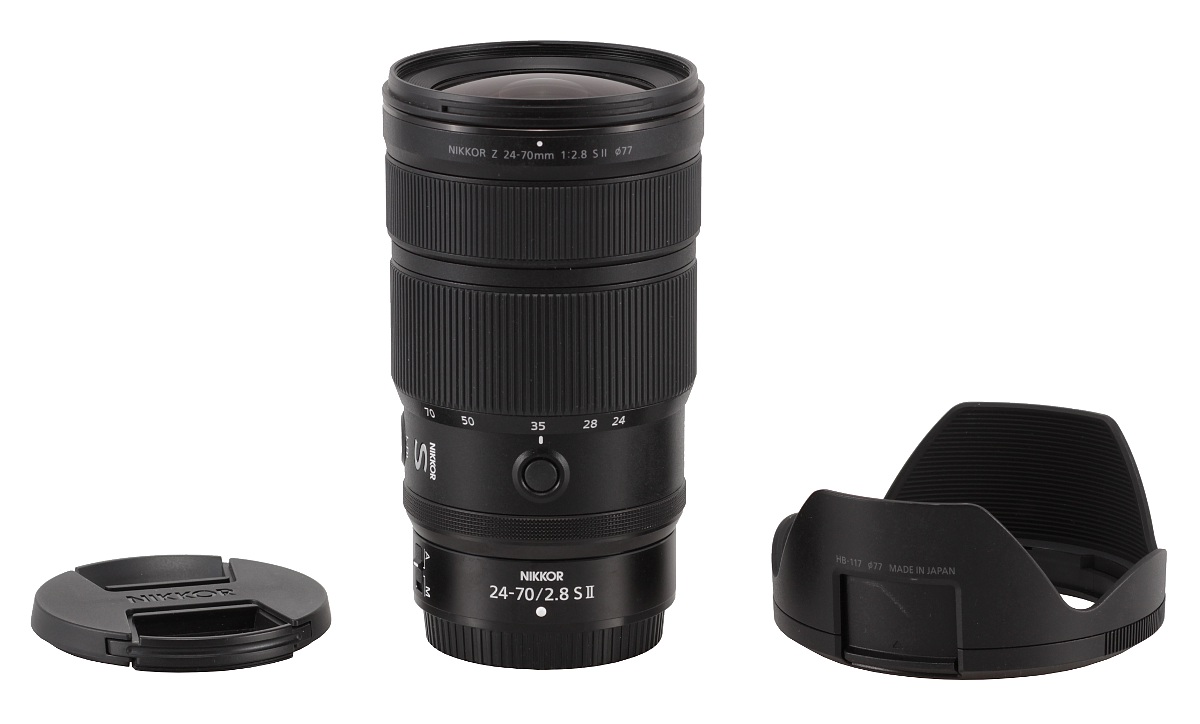
The first part of the proper casing is a metal, black ring, 19 mm wide, which doesn't move. On that ring you can find a white dot, making an alignment with a camera easier, an inscription with parameters of the lens, and the producer's logo. Looking from above and on the left you see an AF/MF switch, allowing you to choose the focusing mechanism mode, and a FULL/LIMIT switch that reduces the focusing range to the minimum distance of 0.33 of a meter.
Turning the lens further you see a whole series of symbols and inscriptions; among them you find information that the lens was produced in Japan, its serial number, and also the focusing range (∞ - 0.24m/0.79ft). It's worth adding that 0.24 of a meter is reached only in the focal range from 24 to 28 mm. At 35 mm it is 0.27 of a meter, at 50 mm – 0.3 of a meter, and at 70 mm – 0.33 of a meter.
Then you see a ribbed control ring as wide as 12 mm; its default function is aperture control but in the camera menu you can allot it other functions as well. The ring can be clicked or declicked.
Further on you find an immobile ring made of plastic, as wide as 22 mm. On it you find a 'Nikkor S' plate, two L-Fn function buttons, and an CLICK ON/OFF switch that is used for changing the working mode of the control ring mentioned above.
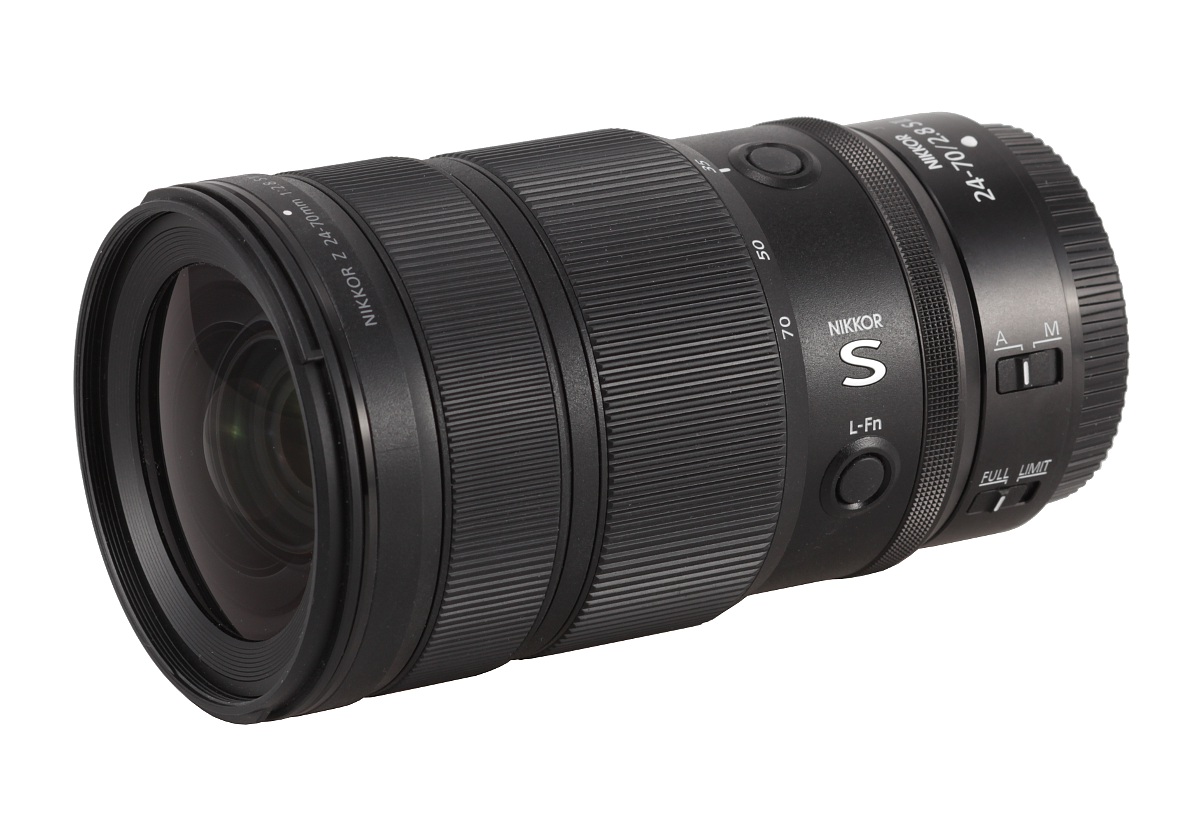
A big zoom ring, as wide as 39 mm, is the next part of the lens. The majority of its surface is covered by rubber ribbing and below you see focal length markings at 24, 28, 35, 50, and 70 mm. The ring moves properly well, although its resistance in the 40-70 mm range is a bit more pronounced than at the shorter end.
Behind the next slight and immobile part of the barrel you find a manual focus ring, 22 mm wide, covered by rubber ribs. It is a focus-by-wire construction and its performance is smooth and properly damped. When you turn it quickly, you need an angle of about 180 degrees to cover the whole range; when you turn it slower you can even reach 750 degrees. Considering the parameters of the lens it is a sensible value, allowing you very precise settings.
The next immobile part of the barrel you see an inscription with the name of the lens, its filter diameter, amounting to 77 mm. This part ends with a mount for a hood that is added in the accessory kit.
Contrary to its predecessor, the change of focal length doesn't change the outer size of the lens. The front element remains immobile and it ensures better weather-resistant properties. It is slightly convex, 59 mm in diameter, and the producers claim it is covered by fluorine coatings that repel water, dust, oil, and ensure easier cleaning. The element is surrounded by a non-rotating filter thread, 77 mm in diameter.
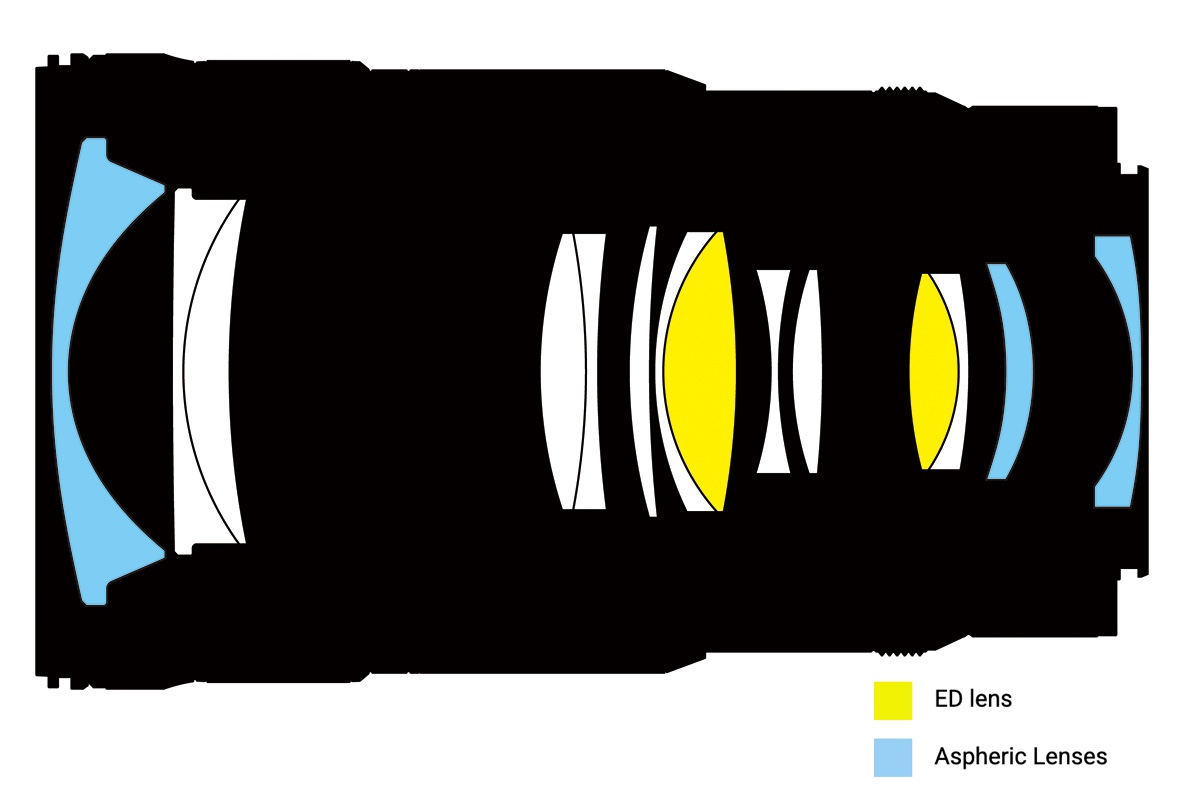
When it comes to optical construction, you deal here with 14 elements positioned in 10 groups. Producers weren't skimping with special elements too – inside you get as many as three aspherical elements along with two made of low dispersion ED glass. Apart from that, there is also a round aperture with nine diaphragm blades which can be closed down to a value of f/22 at the maximum. The producers also boast of efficient ARNEO layers and meso-amorphous layers as well.
Buyers get in the box with the lens: both caps, a soft pouch, and a petal-type hood with a window. I admit at this price point you would expect a solid, hard case being delivered with the lens. The soft pouch (it certainly doesn't deserve to be called a case), included in the box, doesn't protect it practically at all.