Nikon Nikkor Z 24-70 mm f/2.8 S II
8. Vignetting
| Z8, APS-C/DX, JPEG, 24 mm, f/2.8 | Z8, APS-C/DX, JPEG, 24 mm, f/4.0 |

|
|
| Z8, APS-C/DX, JPEG, 45 mm, f/2.8 | Z8, APS-C/DX, JPEG, 45 mm, f/4.0 |

|

|
| Z8, APS-C/DX, JPEG, 70 mm, f/2.8 | Z8, APS-C/DX, JPEG, 70 mm, f/4.0 |

|

|
There are almost no problems at all. At 24 mm and f/2.8 brightness loss in frame corners amounts to just 15% (−0.54 EV) and it decreases to an imperceptible value of 5% (−0.16 EV), on stopping down the aperture to f/4.0.
Please Support UsIf you enjoy our reviews and articles, and you want us to continue our work please, support our website by donating through PayPal. The funds are going to be used for paying our editorial team, renting servers, and equipping our testing studio; only that way we will be able to continue providing you interesting content for free. |
- - - - - - - - - - - - - - - - - - - - - - - - - - - - - - - - - - - - - - - - - - - - - - - -
In the middle of the focal range the results are a tad weaker: by f/2.8 vignetting amounts to 20% (−0.66 EV), but by f/4.0 it is already 6% (−0.19 EV). A slight increase of vignetting you see again at 70 mm, where, at the maximum relative aperture, this aberration reaches 23% (−0.74 EV), and by f/4.0 it decreases to 6% (−0.17 EV).
Still in this category, a cooperation with a full frame detector is a real challenge for the tested Nikkor. First let's glance at the thumbnails below.
| Z8, FF, JPEG, 24 mm, f/2.8 | Z8, FF, JPEG, 24 mm, f/4.0 |

|
|
| Z8, FF, JPEG, 45 mm, f/2.8 | Z8, FF, JPEG, 45 mm, f/4.0 |

|
|
| Z8, FF, JPEG, 70 mm, f/2.8 | Z8, FF, JPEG, 70 mm, f/4.0 |

|
|
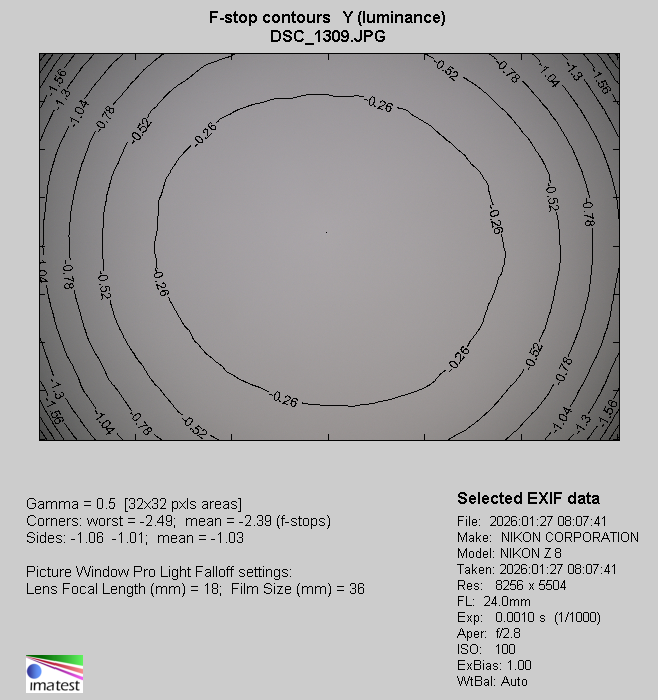
A difficult combination of the widest angle available and f/2.8 means in the corners of your frame will be 56% of light less (-2.39 EV). It is a high value but still a tad better than the level you see in the test of the predecessor.
Stopping down the aperture helps with vignetting and here the new model reacts a bit more efficiently than its predecessor. By f/4.0 this aberration reaches 40% (−1.46 EV), by f/5.6 it amounts to 28% (−0.93 EV), by f/8.0 it reaches 18% (−0.56 EV), and by f/11 it gets to 16% (−0.51 EV). Further stopping down doesn't bring any measurable effects.
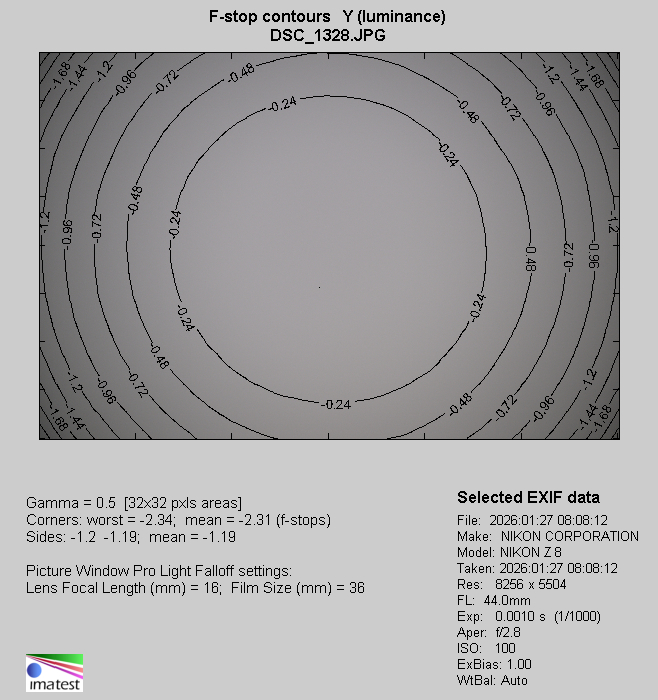
The situation in the middle of the focal range is very similar. By f/2.8 the vignetting reaches a very high value of 55% (−2.31 EV) and here the new model fares a bit weaker than the first version of this lens. Fortunately, stopping down of the aperture is once again more efficient.
By f/4.0 vignetting reaches 36% (−1.28 EV), so here the new model prevails slightly and its advantage will increase fast. By f/5.6 you get a level of 23% (−0.75 EV), and after applying the f/8.0 relative aperture, vignetting decreases to 13% (−0.41 EV). At higher aperture values, vignetting level remains near 13%.
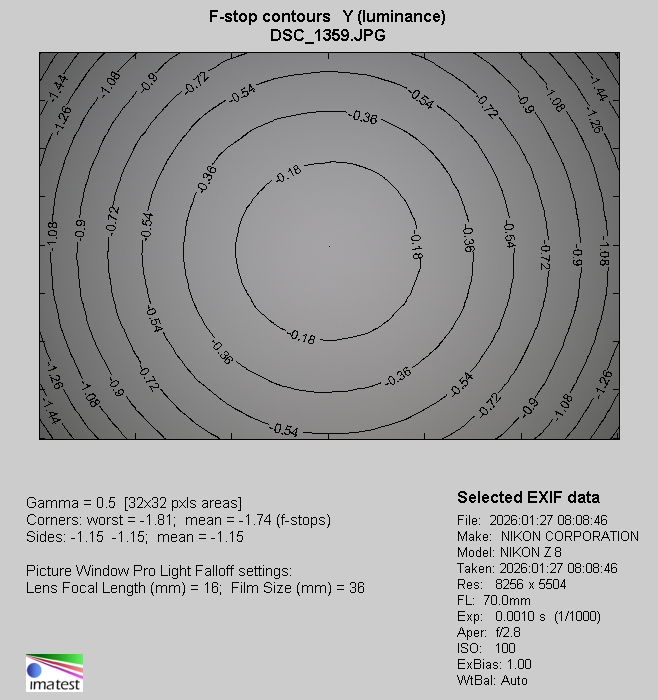
The situation at 70 mm is the best. By f/2.8 vignetting reaches a level of 45% (−1.74 EV) and it is a result by 9 percentage points better than the result of the predecessor. By f/4.0 this aberration decreases to 26% (-0.86 EV), and by f/5.6 to 13% (-0.41 EV). Its level becomes negligible up from f/8.0, where we got a result reaching just 9% (-0.29 EV).
To sum up, the new model performs here slightly better than the predecessor. At both ends of the range its vignetting is lower; in the middle of the focal range it is higher, but at all focal lengths stopping down the aperture limits this aberration much more efficiently. I think it is a step in the right direction.
| Nikon Z8, 24 mm, JPEG, f/2.8 |
 |
| Nikon Z8, 45 mm, JPEG, f/2.8 |
 |
| Nikon Z8, 70 mm, JPEG, f/2.8 |
 |