Nikon Nikkor Z 24-70 mm f/2.8 S II
4. Image resolution
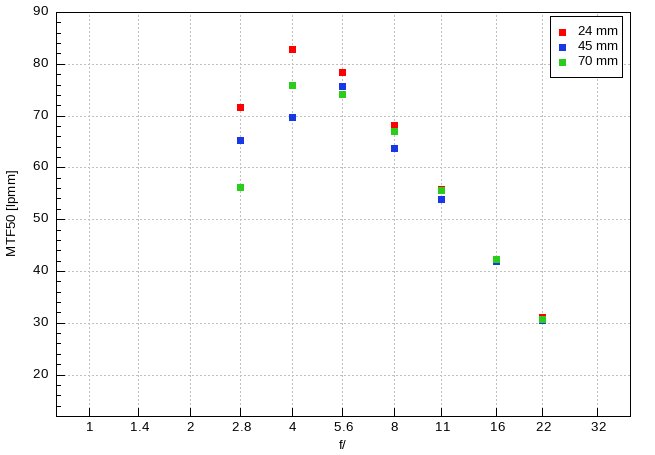
Let's check how the Nikkor Z 24-70 mm f/2.8 S II compares – its results in the frame centre, at 24, 45, and 79 mm presents a graph below. .
Please Support UsIf you enjoy our reviews and articles, and you want us to continue our work please, support our website by donating through PayPal. The funds are going to be used for paying our editorial team, renting servers, and equipping our testing studio; only that way we will be able to continue providing you interesting content for free. |
- - - - - - - - - - - - - - - - - - - - - - - - - - - - - - - - - - - - - - - - - - - - - - - -
The 24 mm focal length fares the best here – already at the maximum relative aperture it is able to exceed 70 lpmm and after stopping down it exceeds even 80 lpmm. Such a performance is worth a good system prime, such results after all we observed while testing many well-put-together f/1.8 Nikkors.
Longer focal lengths are a bit less impressive but still their results are very good. There are no weaker points, even by f/2.8 images are sharp and on stopping down they improve even further.
A huge progress when compared to the performance of the predecessor, is worth noticing in this area. At 24 mm the results can be even by over 10 lpmm better. In the middle of the focal range, that advantage decreases, but still it reaches even 5 lpmm, a meaningful result. The smallest difference you observe is at 70 mm, but also in that place the new model is better. It would be difficult not to praise the new lens.
Now let's check the situation at the edge of the APS-C/DX sensor with the help of a graph below.
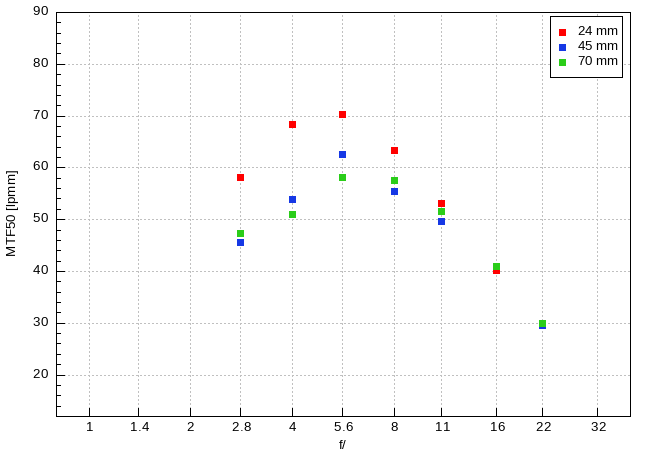
Once again the 24 mm focal length fares the best and is really brilliant. Its advantage over the rest of the range is even more pronounced than before. It is a very sensible thing to take proper care of the shortest focal length in such a model because you need good, even sharpness across the frame or in the majority of it, most often at the wide angle of view. Here again the advantage over the predecessor is clearly seen, reaching at the maximum point almost 10 lpmm.
When it comes to the 45 and 70 mm focal lengths they fare noticeably weaker but still it doesn't mean you get some problems. Even by f/2.8 images are of good quality and on stopping down they become even very good. Still you should mention the fact that here you get no real difference between the performance of the old and the new lens. Sometimes, the older model actually prevails.
Now let's check how the tested Nikkor fares on the very demanding edge of full frame.
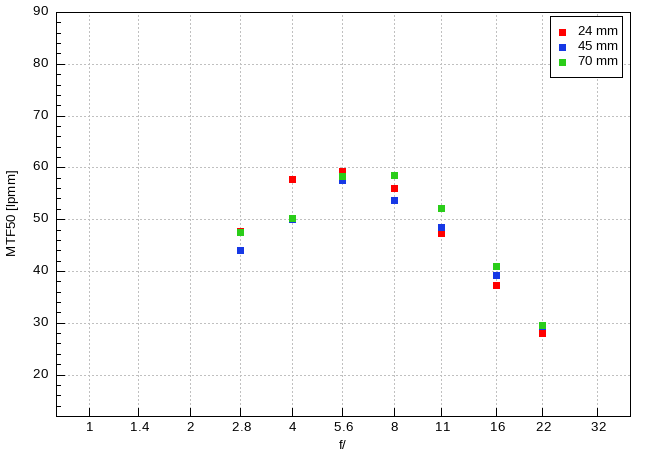
Once again the situation is interesting. The performance at the longer end of the focal spectrum compared to the edge of the APS-C/DX sensor doesn't change almost at all. The results at 24 mm are lower, so you deal with quite even, good performance across the whole focal range. Once again, you can't find any weaker points. Even by f/2.8 you get images of decent quality.
What about comparing the new model to its predecessor? At 24 mm the new lens is able to reach even 8 lpmm higher than the older one. At 45 mm this advantage increases to about 10 lpmm and at 70 mm it decreases to about 6 lpmm. There are no doubts whatsoever that on the edge of full frame the tested Nikkor fares definitely better.
To sum up, you can say that we like the performance of the new Nikkor Z 24-70 mm f/2.8 S II a lot. It fares noticeably better than its predecessor without even a trace of a slip-up – a round of applause!
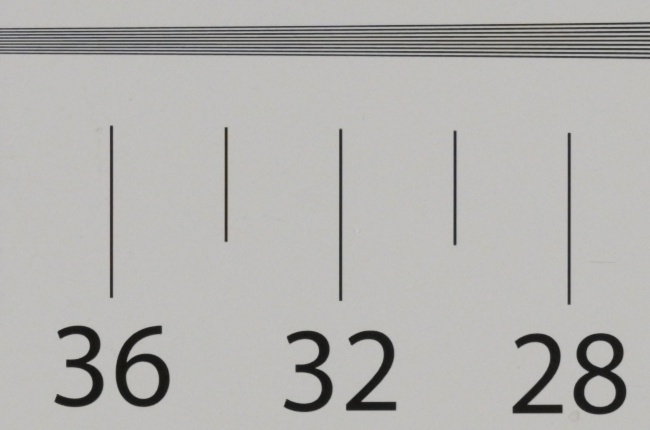
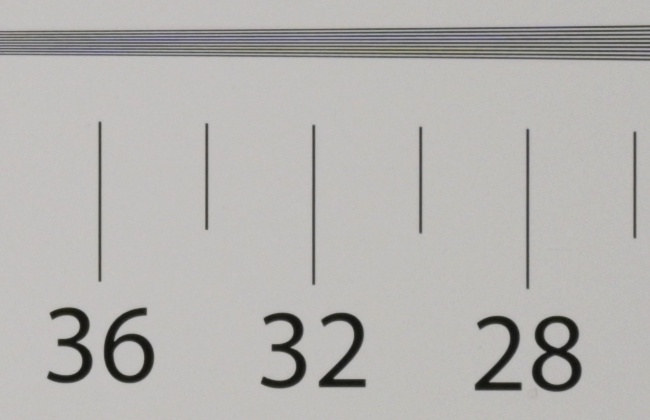
At the end of this chapter, traditionally, we present crops taken from photos of our resolution testing chart, which were saved as JPEG files along with the RAW files, used for the analysis above.
| Nikon Z8, JPEG, 24 mm, f/4.0 |
 |
| Nikon Z8, JPEG, 70 mm, f/2.8 |
 |